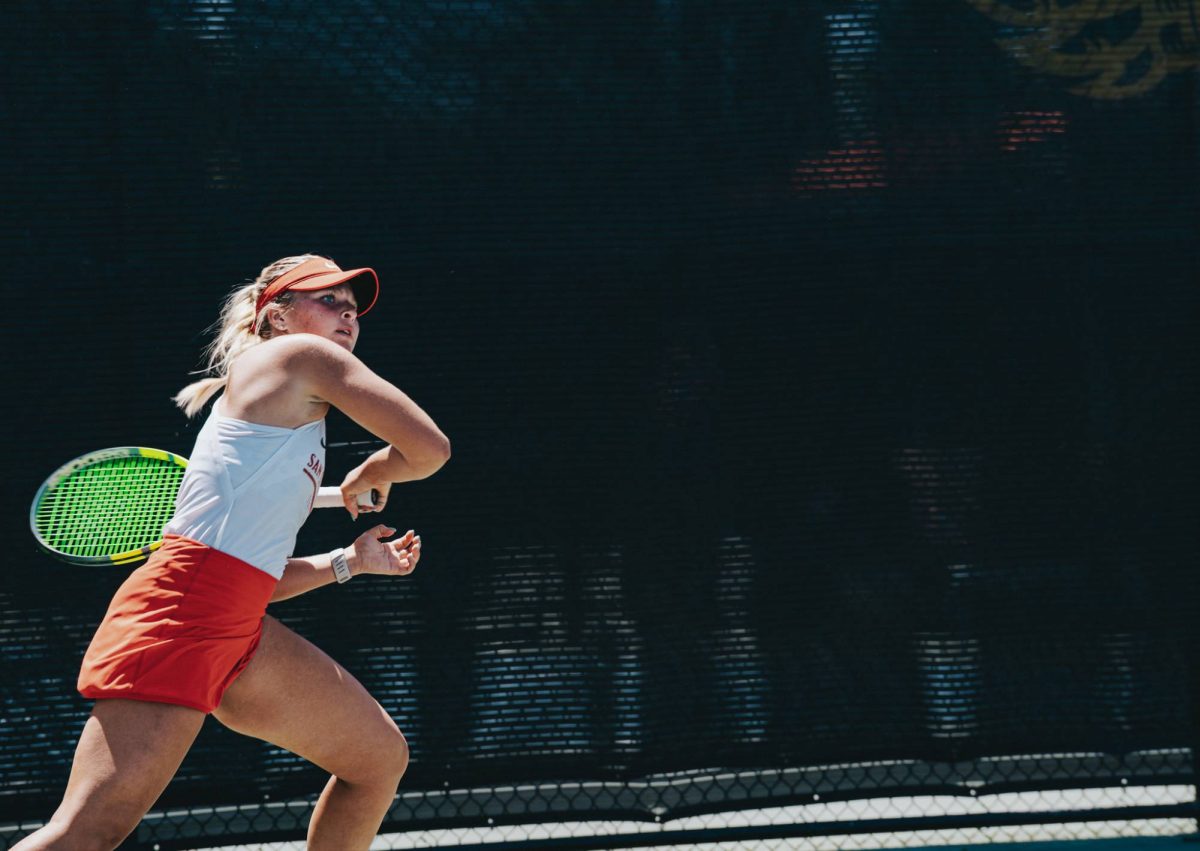
On Friday, Aug. 29, jaded tennis professionals and young hopefuls alike stepped onto the sun-heated courts at the University of San Diego to kick off the Universal Tennis Rating (UTR) Pro Summer Slam National Championships —the last round of a 16-tournament-long series.
The Summer Slam took place at colleges across the country, and to qualify for the Championships, each player at the courts had to win one of the previous Summer Slam Events.
The few rows of lightly shaded seats at the Skip and Hogan Tennis Center held just a few spectators, mostly the players’ families or friends. Players waiting for their matches took cover just outside the fencing of the courts– an ideal spot to watch the other matches and get in some pre-match stretching.
But don’t let the laid-back environment fool you- the Summer Slam Championships hosted players from Valencia, Auckland, sunny San Diego and more– and the stakes for this last round are nothing to sneeze at: the finals winner of the weekend, Robin Anderson for the women and Jangmagnus Johnson for the men, each took home a $4,400 prize.

26-year-old Alicia Herrero Liñana was present at the Summer Slam. Though the non-tennis-fanatic may not know her name, Liñana’s current WTA ranking is 359 in the world in singles and No. 146 in doubles. A native of Valencia, Spain, and coming off two months in Europe, Liñana is taking the time in her twenties to explore the world.
“I think I’m going to get really good matches to work on the things I need to do,” Liñana said of her goals for the tournament. “It’s really good competition.”
Liñana had a dominant first game of the tournament, taking down 18-year-old Virginia Crocker with a result of 1-6, 0-6. Liñana went on to lose just two of her five guaranteed matches, the last of which she retired from.
So, what is bringing all this level of competition to USD?
The UTR tournament isn’t the same all-or-nothing concept of a typical tournament from the International Tennis Federation (ITF). Life as a professional tennis player– and the road to get there– is tough to say the least. There are few summer opportunities, tournaments are often in small, hard-to-access locations, and players often find themselves losing more money than they make. Not to mention, if they lose their first match, they might see themselves out for the rest of the event.

James McKie, Director of Player and Collegiate Development at UTR, explained the unique style of the 450+ events the organization hosts.
“I coached for 12 years, and one of the things that I always felt like college players and aspiring tennis players, professionals, needed was something in the summer that was affordable, but also allowed them to actually improve,” McKie said.
“In our events, because of our format, they are guaranteed the matches,” McKie said. “On top of that, they are guaranteed prize money.”
Money is a significant factor and a major advantage at the UTR tournaments. The winners of each event see themselves $4,300 richer, and even the player who falls in last place gets to walk away with $600.
The prize money has helped Shona Nakano, coming from down under in Auckland, New Zealand, continue to travel the United States and train for her third season at the University of North Carolina at Charlotte.
Nakano’s first Summer Slam was in Virginia. “I went travelling with a friend and that was really cool,” she said. “I came in second, and that motivated me to play more, because I was like, oh damn, I got the prize money.”
“Now I can use that prize money to go to more places, so I went to Boise, Idaho, and I came third there,” Nakano said. She also revealed the complimentary gear players received at the Summer Slam Championships: a Fabletics bag with Fabletics pants and a zip-up, a UTR water bottle, socks and even a sweat towel– complete with a clip for prime mid-match use.
Nakano came into the tournament with the lowest UTR rating but with high ambitions and ready to face some incredible competition. While she didn’t leave the tournament with a win, Nakano put up a valiant fight against seasoned professionals, even finishing 6-7(2) 2-6 against No. 227 in the world and tournament winner Robin Anderson on Friday.

Also competing this weekend was a face familiar with San Diego’s happenings, 24-year-old Kailey Evans, who graduated from USD in May. Coming off an injury, Evans has only returned to compete in the last few months, playing at the Summer Slams in Lincoln, Newport, and taking the win in the finals in San Diego last week.
“[Being back at USD] is really cool because my coaches have been so supportive and they’re able to watch me play,” Evans said. “And, my parents love coming to San Diego, so I know they’ll come out.”
While the Summer Slam finalists weren’t certain if they would leave the weekend with the grand prize, one thing was certain: they left with a tan from sunny San Diego (and, like McKie said, at least a little bit more money).