Golf has been and continues to be a world sport. With the growing prominence of professional tours across the world, many golfers have played courses that feature different grass types and playing conditions, hindering consistent performance.
In a similar way, an increasing number of foreign-born amateur golfers have been coming to the United States to play college golf at the thousands of NCAA programs across the country. A common shared experience by these foreign-born golfers is the tough task of acclimation to American culture and competitive golf.
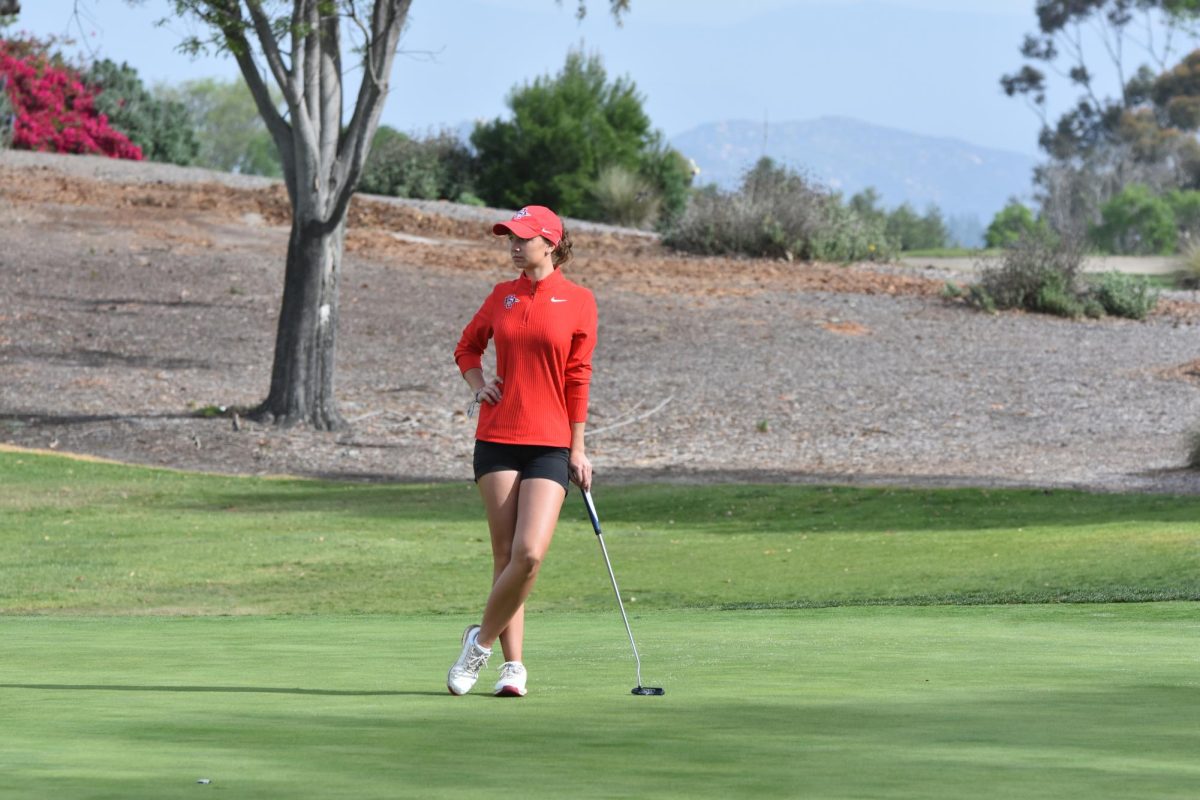
Manon Martin, currently a freshman on the San Diego State University women’s golf team, is no exception to the aforementioned trend. However, head coach Lauren Dobashi has played a huge role in acclimating the young freshman to college golf across the pond.
“When I first came [to SDSU], it was obviously hard, as a foreigner, to adjust,” Martin explained. “[Coach Dobashi] was really comprehensive about [my early lack of adjustment] and, mentally, it really helped my golf [game]. She helped me with a lot of putting and chipping exercises, because the grass is really different from back home, so I had to adjust quickly.”
Other than Dobashi’s instruction and mentorship, Martin expressed her love and appreciation for the Aztecs’ women’s golf program and her teammates. After all, one of the reasons she got into golf was because of the friends she made and the comfort she felt with them.
“I started [golf] because I made some friends [out on the course],” Martin shared. “I liked being with my friends, not really for golf [itself]. But when I started playing great, I started to like it.”
In her early days, Martin followed in her older sister Clémence’s footsteps, as their dad put a club in their hands at a young age. Like her sister, Martin excelled as a young amateur in the French and European golf scene. In fact, she attended École Diagonale, a high school that enabled her to still pursue her education, but also practice golf after school.
2024 is the year Martin began competing, and showing out, in numerous amateur events across Europe. She recorded multiple top-5 finishes, including a two-shot victory at the Grand Prix du Golf PGA France du Vaudreuil in September 2024. Martin garnered much-needed experience in these European amateur events and is the golfer she is today because of them.
“I discovered other levels of golf,” Martin said. “When you know everyone in the field, you know their strengths and everything. But, when you [compete against] new people, it brings a new [perspective] to the game and my improvement.”
Martin’s high-level performance in her pre-college playing days demanded the attention of multiple college coaches across the American collegiate golf world. Similar to the way in which she followed her older sister to a specialized preparatory school, Martin also ventured stateside for college. Unlike Clémence, however, Manon opted to attend SDSU instead of Oklahoma State.
“The weather is a big [reason]; you can play all year,” Martin emphasized. “I talked to coach Dobashi; I really liked her, her personality and everything. I like the area, the campus and the studies, also. In college, I am going to do both [play golf and go to school], so I might as well like it.”

Prior to the fall season this past year and leading up to this spring season, coach Dobashi has grown closer and closer to her lone freshman on this season’s squad. She has taken Martin under her wing, teaching her the ropes of women’s college golf.
While Dobashi has nurtured Martin since her arrival to the Mesa, the road to success and maturity has not always been easy. Martin started in her first two events of her collegiate career, placing T-61 in the Leadership and Golf Invitational and T-42 in The Molly Collegiate Invitational; she also posted three rounds in the 80s during the two tournaments.
Since then, Dobashi forced Martin to take a step back, while continuing to grow as a golfer. She did not start Martin until the Aztecs’ head-to-head match against Long Beach State to begin the spring season.
“I think for [Manon], it was just her belief,” Dobashi explained. “I think we have been working a lot on that, her commitment on the course and her belief in herself. I think the sky is the limit for her; we have made a lot of good progress in just the first half of the year.”
“In the beginning, I think every kid goes through a lot of homesickness, but she adjusted well,” Dobashi also shared. “She is making friends and fitting in with the team. She is a hard worker, and I think she really loves golf.”
Since her gap in playing time, Martin has reached a new level in her unwritten college golf career. She logged 71-75-78 in SDSU’s home tournament for the spring season, the San Diego State Classic at The Heights Golf Club. Overall, she finished in a tie for 25th place and was a few putts away from an even higher finish. Coincidentally, Martin cited putting as the weakest part of her game.
“[My lapse in playing time] taught me that you have to earn your place,” Martin said. “You have to work hard [for a spot], and I am going to do that this spring because I want to play.”
Martin’s work ethic and trending game in her past two appearances have earned her back-to-back Mountain West Freshman of the Week awards. In a sport that breaks you down again and again, especially at a new school in a new country, Martin felt like her “efforts and practices paid off.”
As the spring season carries on, Martin has high hopes for the rest of her freshman year. She aims to build off her lowest 54-hole score at the San Diego State Classic by continuing to lower her scoring average and capitalize on her precise ball striking. After the tournament at The Heights, Martin said her goal is “to win a tournament, [either individually] or with the team.”
In regards to her playing career after college, Martin’s future will be dependent upon her remaining years of eligibility. However, signs point to the professional golf route.
“I do not know yet if I am going to go pro,” she said. “I think I will see at the end of college if I have the [talent] level; that is the biggest question.”