

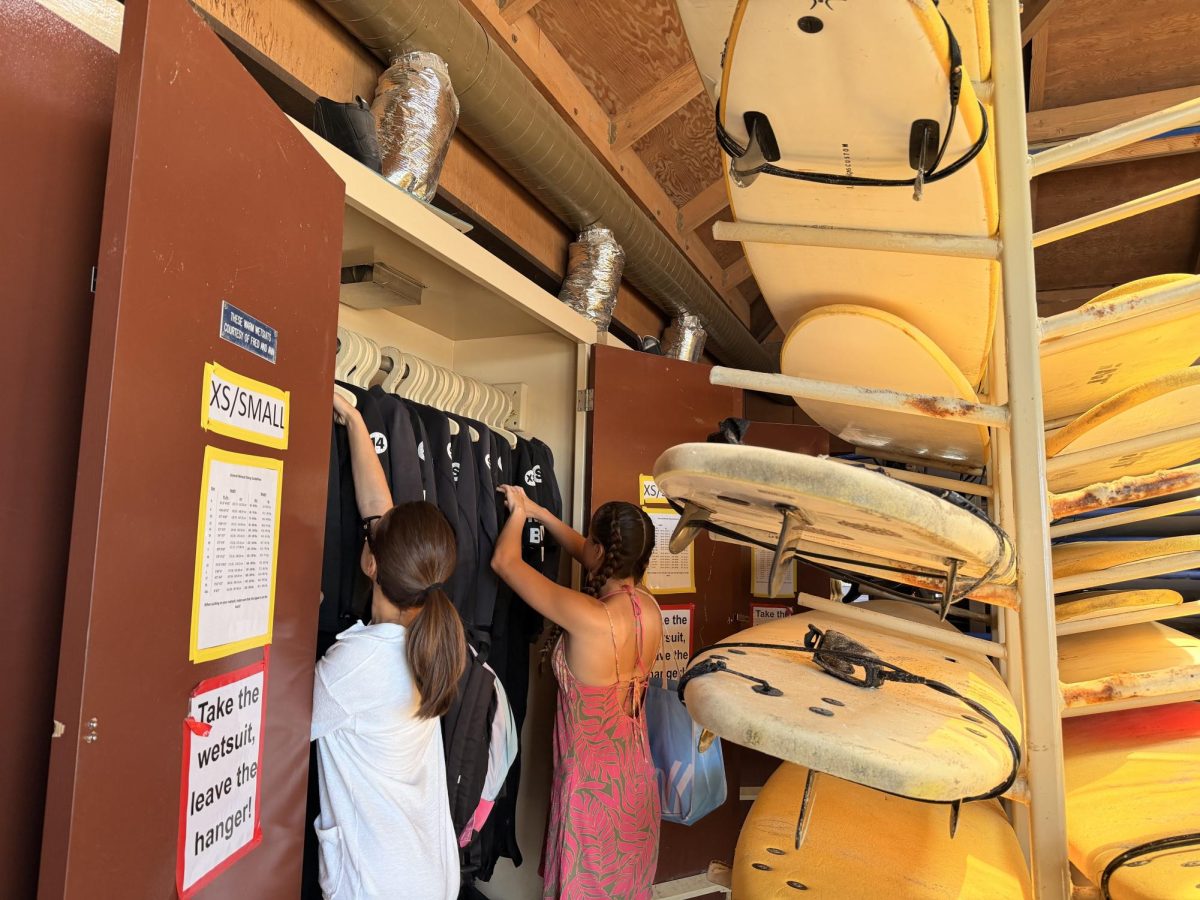
Though it is situated relatively far from the coast, the surf culture and atmosphere at SDSU is almost palpable. Surfboards and wetsuits populate apartment balconies, and flip flops thump along the concrete of the student union. Surfing, even for those who don’t participate, is a prominent aspect of student culture at SDSU.
SDSU takes advantage of its location by offering class credit for surfing, paddle boarding, wakesurfing and other water sport courses. Offered in collaboration with Mission Bay Aquatic Center (MBAC), an affiliate of Associated Students, ENS 122: Surfing is the beginner surfing course at SDSU.
While surfing can often come across as an activity not very welcoming to beginners, MBAC wants to foster an environment in which newcomers are warmly accepted, not ostracized.
“These courses are a welcoming entry point for students looking to become part of surf culture,” said Jamie Eubanks, an instructional coordinator at MBAC. “Emphasizing water safety, awareness, etiquette and understanding personal limits helps students enter the ocean with a sense of responsibility for themselves and others around them.”
There is a course fee of $180, which covers the rental of a wetsuit, surfboard, and instructional time for the semester-long course, consisting of 12 sessions.

The course begins with online modules prior to entering the water. These modules focus on water safety, tides, equipment and understanding the conditions of the ocean. After these introductory modules, students move to Mission Bay to learn proper surfing form and practice their pop-ups, the swift motion of standing up on a board.
“[We learned] how to paddle at certain speeds, how to turn your board and all that stuff, so then when we got out into Mission Beach, it wasn’t just cold turkey,” said Alexa Lamoria, a student who took the surfing course in Spring 2025.
After learning the basics, students walk to Mission Beach to start surfing. Wetsuits, surfboards and flip flops in tow, students are able to walk from MBAC to where the waves are breaking.
“All classes take place at Mission Beach in an area with a sandy beach break, meaning students surf over a soft bottom, which is more forgiving than reef breaks with rock or cobble,” Eubanks said. “Within that zone, instructors choose specific paddle-out locations based on currents, wave shape and what will be most manageable for the group.”
Once students have completed their training in Mission Bay, the rest of the class takes place at Mission Beach, meeting weekly. While ENS 122 is a beginner course, MBAC also offers intermediate and advanced surfing courses, available to students who already have experience in the water.
Grading for the course is not based on surfing ability, but instead focuses on showing up consistently, ready to get in the water.
“You do not need to be getting barreled to earn an A,” Eubanks said. “Just keep showing up, improving your awareness and getting more comfortable having fun in the ocean.”
Ellarose Menezes, a student who took the surfing course in Spring 2025, had some previous experience surfing, but chose to take the course with her friends to gain more experience.
“Without that class, I would not have been consistently going every week, and that forces you to be in the water every week and actually practice,” Menezes said.
After the course ended, Menezes bought her own board and is now able to surf at beginner breaks around San Diego.
“I probably wouldn’t have [bought a surfboard] if I hadn’t taken that class, because it did kind of show you how easy it is to get down to the water once a week and just surf,” Menezes said.
Lamoria and Menezes both expressed interest in taking the beginner course again, as well as continuing to advance through the levels of instruction at MBAC, from intermediate to advanced.
“Because we’re in San Diego, why not learn how to surf,” Lamoria said. “But also, it’s one of those life things where you learn how to play tennis, that’s a life sport. You learn how to ski, that’s a life sport. I think surfing is also one of those things.”
Nearly 30 minutes from the coast, many SDSU students are willing to make the trek to hone their skills at the beach. Though the university is further from the water compared to other San Diego schools, students are committed to the coastal lifestyle, made more attainable by this course.
“It provides an affordable and accessible way to learn to surf in a structured, supportive environment,” Eubanks said.
“It didn’t feel like a class, you just were going down to the beach and surfing with your friends,” Menezes said. “It was very fun. I would say 100% I would take it again.”


