The clean, white walls of the Richard Anthony Marks gallery were met with a pop of color when the “Vibrant Notes” collection was put on display on Sept. 2.
The gallery is small, but Marks’ paintings fill the cozy space with a vivid showcase of how the art forms of music and color can be intertwined.
On display until Sept. 25, the exhibition features a collection of abstract paintings from the 1960s and 1970s, depicting different variations of still-life objects.
Marks, a San Diego native, received his Bachelor’s degree from San Diego State University’s School of Art and Design in 1963 and obtained his Master of Fine Arts degree from SDSU in 1964. Some of the paintings in the exhibit were part of Marks’ 1964 MFA thesis exhibition, titled “Eleven Variations of a Still Life.”
The exhibition also contains archival items, such as newspapers from the 1960s and 1970s, showcasing the recognition Marks has received throughout history.
Marks, now living in Chula Vista, CA, visited the gallery for its private ribbon-cutting ceremony on Sept. 12, giving visitors an opportunity to meet the man behind the canvas.
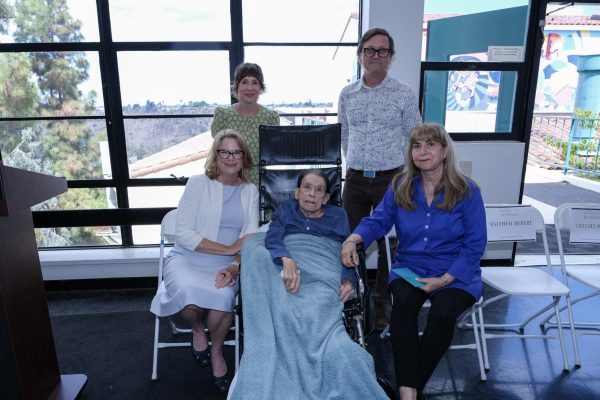
“The selection on display is a small fraction from a prolific artist,” said Chantel Paul, the SDSU Galleries coordinator. “There are over a hundred pieces that could have been exhibited, but I had to be specific in the choices for the exhibition. Because of that, we’re able to show work that traces his career from his time as an MFA through the decade that follows.”
“Vibrant Notes” showcases the relationship between the art of music and painting, as many of the gallery’s pieces were influenced by the melodies that Marks listened to while in the midst of creating.
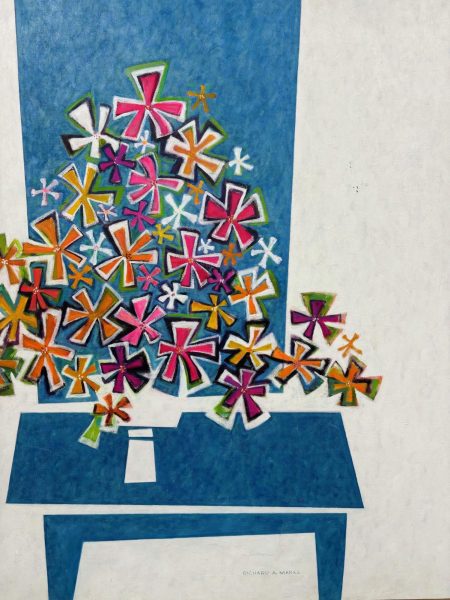
Marks’ use of warm or cool colors was dependent on the notes of the music he listened to while at work, and whether those notes were higher or lower on the musical scale.
Marks is not the first painter to create works heavily influenced by music. Music has long been a driving force in the arts, inspiring painters for generations, such as Jackson Pollock, Henri Matisse and Jean Michel-Basquiat, all of whom were heavily influenced by jazz music.
“There is an incredible amount of animation and movement in his paintings, especially through brush stroke and texture, that can be found in all of his artworks,” said Paul. “Visually, the vibrations and relationships between the colors and composition are very active. Richard was very in tune with his materials and it is present in the artworks.”
Upon entrance to the gallery, the left side consists of paintings that use deeper and warmer shades, while the right side features loud, neon colors that immediately demand one’s attention.
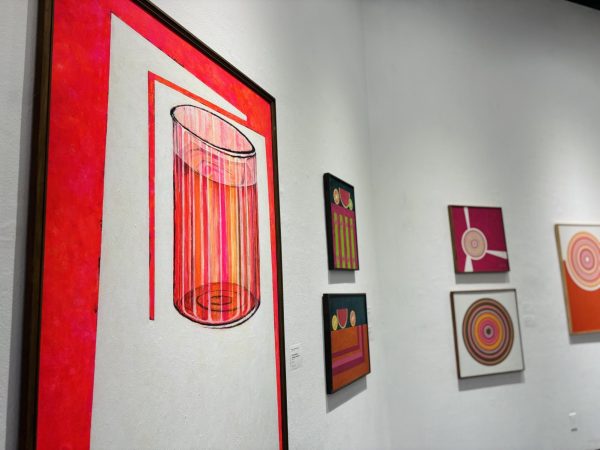
“Still Life Composition with Beaker of Water #XXV” (1966-67) is the most vibrant of all the paintings, as the art gallery lighting makes the neon paint appear to be almost glowing.
Bright palettes, clean-cut geometric shapes and unique abstract interpretations are recurring themes in the art pieces.
One of Marks’ untitled paintings from his “City Study” series uses oil paint to construct an abstract rendition of a city skyline. While the painting may simply look like a collection of unrelated shapes at first glance, the metropolitan-esque image comes into vision once viewers read the title of the work.
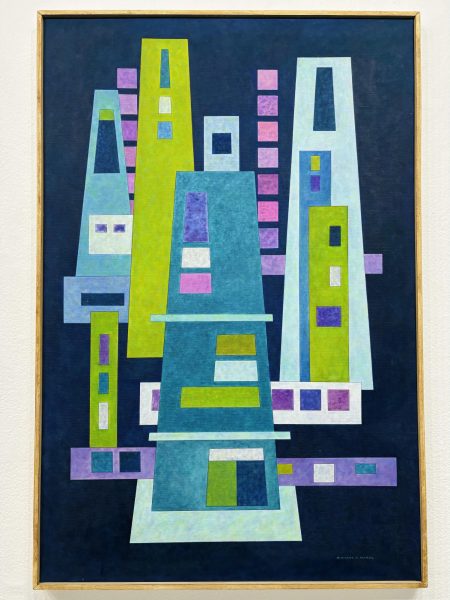
One of the fascinating qualities of abstract art is that no two abstract painters are remotely the same. Abstractionism encourages artists to use their imaginations, experiment with the unconventional and play with the freedom of their interpretation.
“Each artwork, whether abstract or representational, brings an opportunity to experience deft technique and a pure commitment to reimagining the world around us,” reads the poster at the front of the “Vibrant Notes” collection.
The “Vibrant Notes” exhibit will run until Sept. 25 in the Richard Anthony Marks Gallery at SDSU.