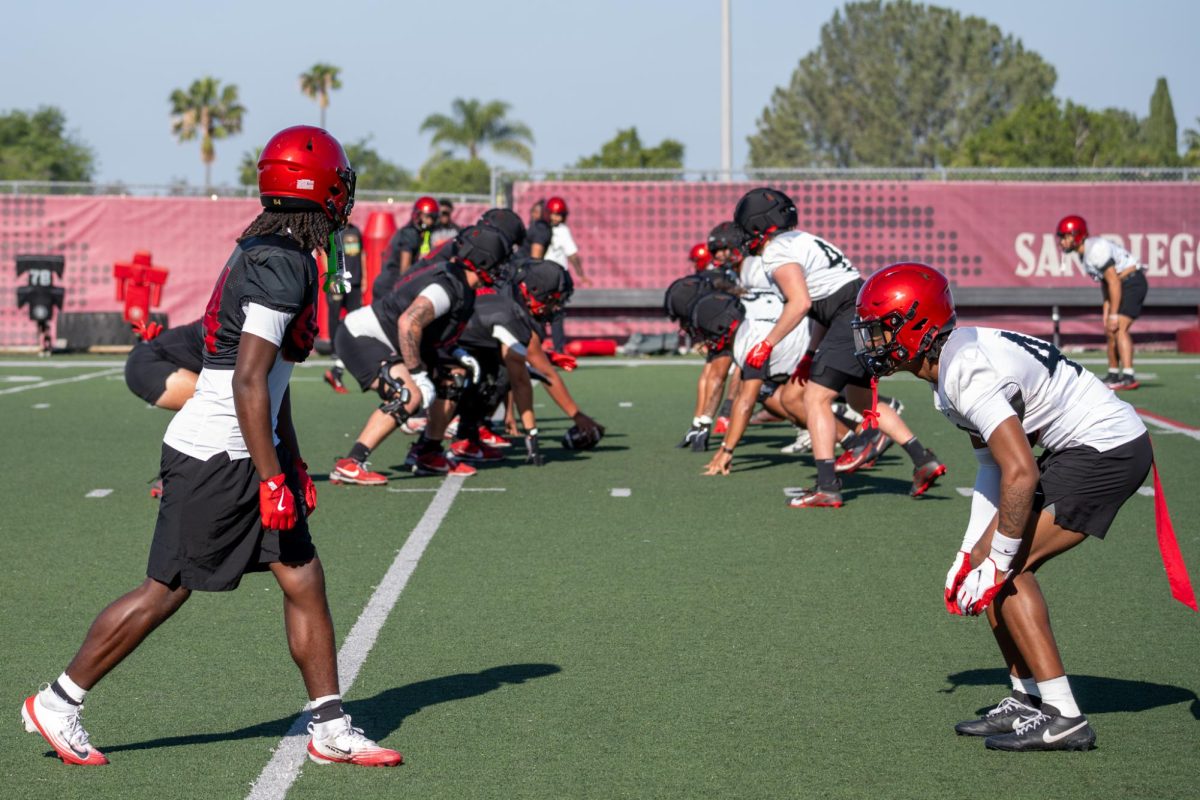
The joke from Wyoming’s head coach, Jay Sawvel, when the Cowboys visited San Diego State on Nov. 1, was that SDSU’s latest promotion was to “come dressed as an empty seat.”
J.D. Wicker isn’t laughing; he’s trying to make sure those seats are filled before the Aztecs walk into the Pac-12.
Speaking at Voice of San Diego’s Brews & News live podcast, SDSU’s director of athletics was direct about the empty pockets of Snapdragon Stadium, even in the middle of a strong 8-2 season.
When Snapdragon opened in 2022, SDSU sold 15,569 season tickets, selling 99% of their premium seats. Wicker recalled that the stadium’s first impression became a long-term hurdle to consistently selling tickets.
“Unfortunately, what is it they say, a first impression is very important?” Wicker said. “That first impression was 110 degrees that first day, and then we followed that up with a hurricane…I think that impacted us.”
Now the on-field product has caught up. Under head coach Sean Lewis, SDSU has risen from 3–9 to the top of the Mountain West and is preparing for its first season in a restructured Pac-12. For Wicker, the conference shift matters.
“Being in the Pac-12 going forward is going to be better for us,” he said. “The PAC-12 name carries a lot of weight across the country, so it’s going to be more recognizable. The competition in the league is going to be better, top to bottom… if you’re winning the league against better competition, that’s going to give you better opportunities.”
Ticket prices and a stadium SDSU had to build itself
San Diego Supervisor Jim Desmond’s public letter urging SDSU to lower ticket prices put the program under scrutiny. Wicker didn’t shy away.
“I think about the fact that we built this stadium. San Diego State built this stadium,” he said. “The County of San Diego didn’t help us. The City of San Diego didn’t help us. The city of San Diego charged us more than market rate for the property so that we could purchase it, so we could build the stadium.”
That financial reality shapes SDSU’s pricing strategy.
Wicker said costs have decreased since Snapdragon opened, and SDSU has added incentives, such as discounts and priority access to concerts and SDFC matches. But there’s a balance he refuses to break.
“I have to protect the season ticket holder who’s investing in all six games. I can’t charge $500 for a season ticket and then sell that seat for $25 on a single game purpose,” he said. “Because why would somebody buy a season ticket if they can just cherry-pick the game?”
“If you want us to be successful, you’re going to have to invest,” he added. “We are San Diego’s football team. If we’re going to be successful, it’s because our fans come and we generate ticket revenue.”
He even turned Desmond’s criticism into a grin-worthy promise.
“Next year, we are going to increase season tickets at Snapdragon Stadium for Aztec football,” Wicker said. “And one of those is going to be supervisor Jim Desmond.”

‘They work really hard, and they should be supported better’
While the pricing debate plays out publicly, SDSU players and staff have taken their own approach to building crowds — one classroom at a time.
“The team’s been awesome,” Wicker said. “Sean and his staff and the players want more people in the building. They work really hard, and they should be supported better.”
He credited the football program, marketing staff and ticketing office for coordinating ticket giveaways during classroom visits, as well as student-focused incentives like the “Danger Zone,” a stadium activation during the fourth quarter of home games.
“It’s been initiatives that we’ve worked through within the entire department,” he said. “It’s been the football team doing things where they can go out and do what they want to do. And it’s been the marketing department, our ticketing department, working hard to put together solutions to get people into the building.”
Even with strong student ticket demand, SDSU faces a unique challenge in college culture: halftime exits.
“It’s important to come and support the team and to be there for the entire game,” Wicker said. “That’s just kind of been a culture that we’re trying to figure out — how do we crack that culture and have students that will come and stay for the entire game?”
The Boise State win this past Saturday in pouring rain gave Wicker hope.
“We had a great group that stayed for all four quarters last weekend in the rain,” he said. “So hopefully we can continue building on that.”
Heat complaints, soccer comparisons and the push forward
Snapdragon’s hottest days left a lasting impression, but Wicker pushed back against the idea that San Diego heat is uniquely prohibitive.
“It’s hot all over the country,” he said. “You’re going to a sporting event. Bring sunscreen, bring a hat, and if you need to sit in the shade or hang out in the shade for a few minutes, you can do that too.”
Meanwhile, across the stadium, San Diego FC’s booming supporter culture has drawn comparisons. Wicker said SDSU has taken notice.
“Soccer has its own culture,” he said. “Their supporter group is something unique to soccer. We have The Show. So, can we do something more with our students to create some type of football-centric supporter group? That’s something that has definitely been bantered about.”
For Wicker, the future hinges on sustaining the momentum SDSU has finally created on the field.
“It’s an exciting brand of football now, which is what people have asked us for,” he said. “We know people will come because we’ve seen it before. So we’ve just got to figure out how to get them to come on a consistent basis.”