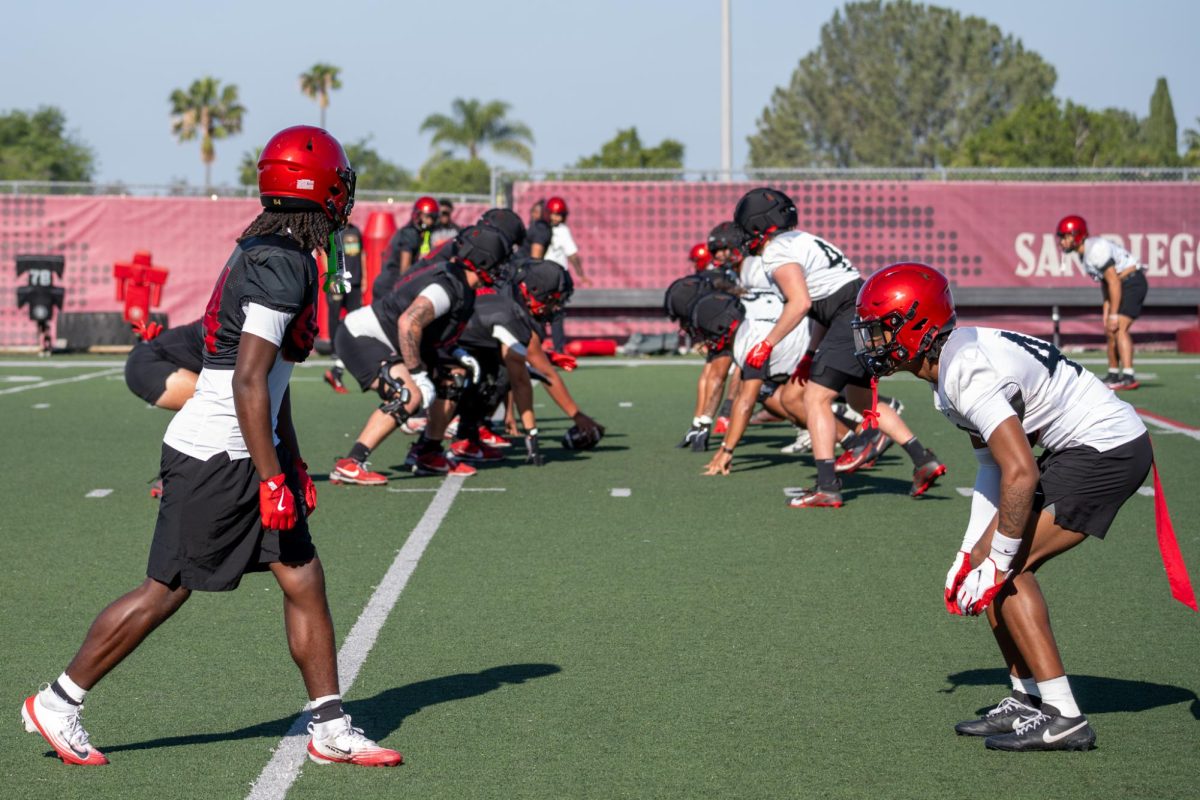
San Diego State opened the early signing period Wednesday by securing the highest-rated recruiting class of the Sean Lewis era, now officially a 23-player haul, one the second-year head coach described as a defining step for the Aztecs as they prepare to enter the Pac-12.
“It’s a strong class,” Lewis said. “It’s our highest-rated class that we have put together. It’s our first Pac-12 class. We beat out multiple Power Four programs for a lot of our signees.”
The updated class features 17 recruits from California, with the rest coming from Texas (3), Washington (2) and Hawai‘i (1). Twenty-one of the signees are coming straight from the high school ranks, reflecting what Lewis called the backbone of SDSU’s long-term roster philosophy.
The Aztecs enter signing week at 9–3, completing a six-win turnaround from last season’s 3–9 finish, matching the largest year-over-year improvement in program history (since 1921). SDSU awaits its bowl destination on Sunday.
This year’s early signing period is also the first conducted under the NCAA’s new model, following the elimination of the National Letter of Intent and its replacement with financial aid agreements. The early signing window runs from Dec. 3–5, with the regular signing period beginning Feb. 4, 2026.
Keeping San Diego talent home
Local recruiting was a clear priority for Lewis and his staff. The centerpiece is La Jolla High School wide receiver Carson Diehl, one of the most productive two-way players in the San Diego Section.
“I think he’s the best two-way player here locally,” Lewis said. “To see his competitive nature, his leadership traits and then his physical tools — his size, his length — it’s really, really impressive. Excited to keep him home, and we want to keep all of our hometown heroes home.”
The Aztecs also added Lincoln High School defensive back Cammeron Purnell, the KUSI Prep Pigskin Report Defensive Player of the Year, who flipped from Oregon State in the final days of the cycle.
Texas pipeline continues with speed and versatility
For the second straight year, SDSU struck gold in Texas, adding explosiveness at multiple skill positions.
Wide receiver Derek Stevenson (Katy, Texas) averaged 26.8 yards per catch as a senior and finished third in the state in the 100 meters.
“Derek was a guy that we identified early on,” Lewis said. “He has a lot of position flexibility. We put a premium on speed, a premium on length. He’s shown good development in his craftsmanship as a wide receiver.”
Running back Josiah Lucas (South Grand Prairie, Texas), who rushed for more than 3,000 yards over the past two seasons, joins an SDSU backfield Lewis described as a natural fit.
“Josiah is a well-rounded back that we feel like can do all things really, really well,” Lewis said. “He’s got some real horsepower. He shows great change of direction on his tape. He’s got some make-you-miss ability.”
Quarterback Brady Campbell — a Bakersfield Frontier High product who recently flipped from New Mexico State — gives SDSU a long-term developmental piece under center.
Wide receiver Daishaun Davis (San Jacinto), another California standout, brings top-end speed and big-play ability after recording nearly 500 receiving yards as a senior.
Reinforcements in the trenches
SDSU added major size and athleticism along both lines of scrimmage, a priority in the program’s transition to the Pac-12.
The offensive line group includes:
- Brian Borjon, 6-6, 275 pounds — younger brother of current SDSU starter Joe Borjon
- Harlem Nellum, 6-5, 350 pounds — a physical run blocker who flipped from UNLV
- Jarvis Williams, 6-5, 330 pounds — one of the class’s strongest performers in camp testing
Tight end also received a boost with Jack Ellis, a 6-6 target from St. Vincent de Paul, and Elijah Muliufi, a 6-7, 270-pound two-way athlete from Washington whom SDSU projects as an in-line tight end with rare size.
“You want guys with size, length, speed, horsepower that you can then develop and train,” Lewis said.
Along the defensive front, SDSU signed Roman Paseka, Koi Taiese and Dominic Coelho, each an all-section disruptor with college-ready frames. Robby Lavata‘i, a 6-3 edge rusher from Washington with burst and length, also joins the group after posting double-digit sacks as a senior. Edge standout Crosby Kelly joins the group, too, after earning Diablo-Foothill League Co-Defensive MVP honors.
Adding length and physicality on defense
Lewis emphasized defensive versatility throughout the class, reflected in a group built on size and athleticism.
The secondary additions include:
- Dareon Edmonds, CB — chose SDSU over UCLA, Boise State and Washington State
- Tainoa Lave, S — two-time All-Hawai‘i selection
- Rahmeer Henderson, S — a rangy two-way athlete
- Jamison Starks, CB — a junior-college standout with three interceptions this fall
At linebacker, the Aztecs added:
- Javari Nash — 71 tackles, four interceptions
- Alijah Lash — one of Texas’ top edge-bending linebackers
- Jeremiah Lewis — a high-impact junior-college defender from College of San Mateo
Evaluating defensive recruits, Lewis said, requires understanding how players respond once they arrive on campus.
“The biggest challenge is what they’re going to act like and who they’re going to be when they get away from home,” Lewis said. “When you take them away from mom and dad, how are they going to react? What level of adversity have they had in their life?”
High school foundation remains core of SDSU’s philosophy
Even as the transfer portal continues to reshape college football, Lewis said SDSU’s identity remains rooted in player development.
“I still believe in building it mostly through high school recruiting,” he said. “High school recruiting is going to be the core and the backbone of what your roster is. That’s like the NFL Draft. Then you utilize the portal as free agency.”
Lewis said the Aztecs will turn to the portal to fill selective depth needs, particularly as the roster turns over heading into its first Pac-12 season. But the long-term plan remains unchanged: stack strong high school classes and develop them into championship-caliber contributors.
“It’s imperfect humans evaluating imperfect humans,” Lewis said. “Who is ready to go win a championship? And where are the holes we need to fill through the portal?”