

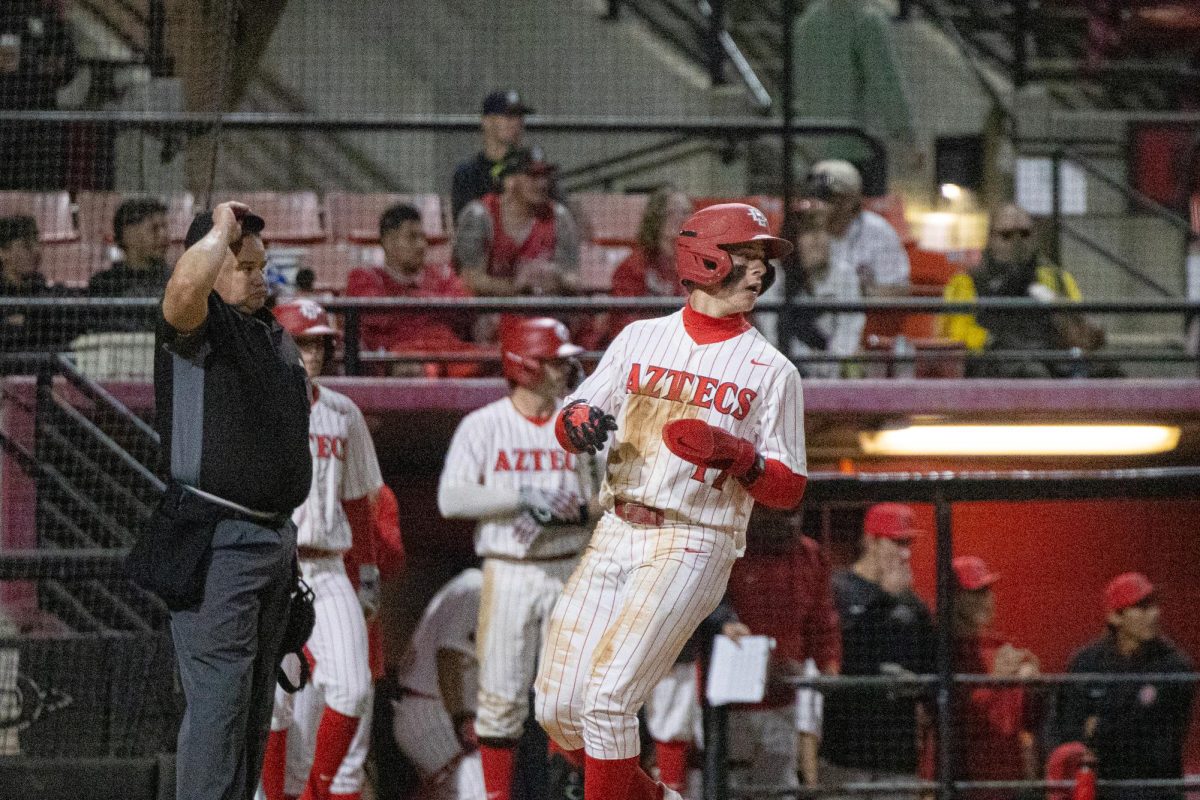
Max Farrell didn’t grow up dreaming about wearing just any college baseball uniform. He grew up dreaming about baseball itself: the routines, the repetition and the quiet lessons passed down without speeches.
Baseball was always there. His father played at San Diego High School. His older brother followed the same path. Fields, practices and long afternoons became normal before Farrell ever realized what the game might eventually give back.
“It was just something that was always around,” Farrell said. “I didn’t really have a choice, which I’m glad about.”
That’s what separates Farrell’s story from most freshman profiles. This isn’t about a breakout moment or a viral highlight. It’s about inheritance, learning how to work before learning how to win.
“They always led by example,” Farrell said of his family. “They showed me how to do things the right way. When I don’t feel like doing something, I think about them just trying to get better every day.”
For Farrell, baseball became serious not with one swing or one offer, but with realization. Early in high school, interest from college programs, including San Diego State, made the end goal feel real.
“I kind of doubled down,” he said. “I realized this was the right path for me, and it gave me the motivation to keep going.”
Max Farrell attended San Marcos High School in North County San Diego, being a four-year varsity letterwinner. According to MaxPreps, he hit .30 with 17 home runs, 74 RBIs and 76 runs scored across 98 games. Farrell also added 23 doubles, three triples and 24 stolen bases during his high school career. Finding his way into the lineup, whether it was in the infield, outfield or DHing, Farrell made sure to stand out inside the field.
As a senior, Farrell earned first-team all-CIF San Diego Section honors after slashing .33/.462/.750 with nine home runs and 33 RBIs, leading his team to a Coastal Conference regular-season title. His performance earned him a spot in the San Diego Padres High School All-Star Night at Petco Park and recognition as one of the top infield prospects in the state.
Farrel’s success extended beyond the San Diego section. He was rated among the top infielders in California and listed as a Top 500 national recruit by Perfect Game, while also earning preseason all-region recognition multiple times. Prior to arriving at SDSU, he was named the 2026 Mountain West Preseason Freshman of the Year by Perfect Game.
He committed to SDSU during the fall of his sophomore year, a decision that felt less like a leap and more like alignment. His mother attended the university, his family was nearby and the idea of playing college baseball in the city he calls home carried weight.
“Being from San Diego and having my parents able to come watch me play every weekend was huge,” Farrell said. “With the academics, the weather, it just felt right.”
“San Diego is paradise,” he added. “Nothing beats it.”
But staying home didn’t mean staying comfortable.
When Farrell arrived on campus, the jump to Division I baseball introduced a new pace: faster practices, deeper rosters and fewer guarantees.
“It’s definitely a lot tougher,” he said. “The talent, managing everything. There’s so much more to learn at this level.”
Early on, Farrell felt the challenge most on defense. The margin for error shrank and daily improvement became non-negotiable.
“Coming in early every day, getting work in with the coaches, paying attention to detail — that’s helped a lot,” he said. “I’m happy with where I’m at, but I know there’s still a lot of room to grow.”
Like many freshmen, Farrell arrived with quiet doubts. Not about effort, but about belonging.
“There were a lot of doubts going in,” he said. “I’d never experienced this before.”
What changed wasn’t one moment, but repetition. Competing. Learning. Holding his own.
“Through competing,” Farrell said, “I feel like I belong.”
That belief shows up in ways that don’t always reach a box score. Head coach Kevin Vance sees it every day.
“He’s the type of player you dream about as a coach,” Vance said. “He works. He was voted by his teammates as the hardest worker on the team, as a freshman.”
Vance also highlighted Farrell’s leadership and the example he sets through his daily approach and the relationships with teammates. That influence has helped him gain trust quickly.
“He leads by example,” Vance said. “He’s a huge part of our camaraderie, and the guys rally around him. He’s a definite captain in my book.”
Vance points to Farrell’s versatility and consistency as evidence of his value.
“He’s never going to give up an at-bat,” Vance said. “He’s super versatile and can play a lot of positions. He’s a jack of all trades.”
But Farrell’s impact extends beyond drills and depth charts. Inside the dugout, he’s known just as much for his energy as his preparation.
“I try to be the goofy freshman,” Farrell said. “I like making people laugh, hanging out and connecting with everyone.”
Prior to arriving at SDSU, Farrell was named Mountain West Preseason Freshman of the Year by Perfect Game earlier this month. Meanwhile, he started all the first three games posting with four RBIs, six runs scored, and two stolen bases.
Away from the field, Farrell is still unmistakably a San Diego kid, grabbing food at The Taco Stand in Encinitas, heading to the beach and playing spikeball with friends whenever the sun is out. The city isn’t just where he plays; it’s where he lives.
That’s why his presence matters to SDSU. Farrell represents something familiar and rare: a local player who stayed, not because it was easy, but because it meant something.
“Pressure is a privilege,” Vance said. “He’s really proud to wear San Diego State on his jersey.”
As Farrell looks ahead, he doesn’t define his freshman year by numbers or titles. He defines it by foundation.
“I’ve been hearing that college flies by,” he said. “I want this year to be about learning, experiencing things for the first time and just living life as a freshman.”
For San Diego State, Farrell’s story isn’t about what he will become someday. It’s about what he already represents, a connection between city and program, between work and opportunity.
For Farrell, it’s simpler.
He’s home. He’s learning. And he belongs.


