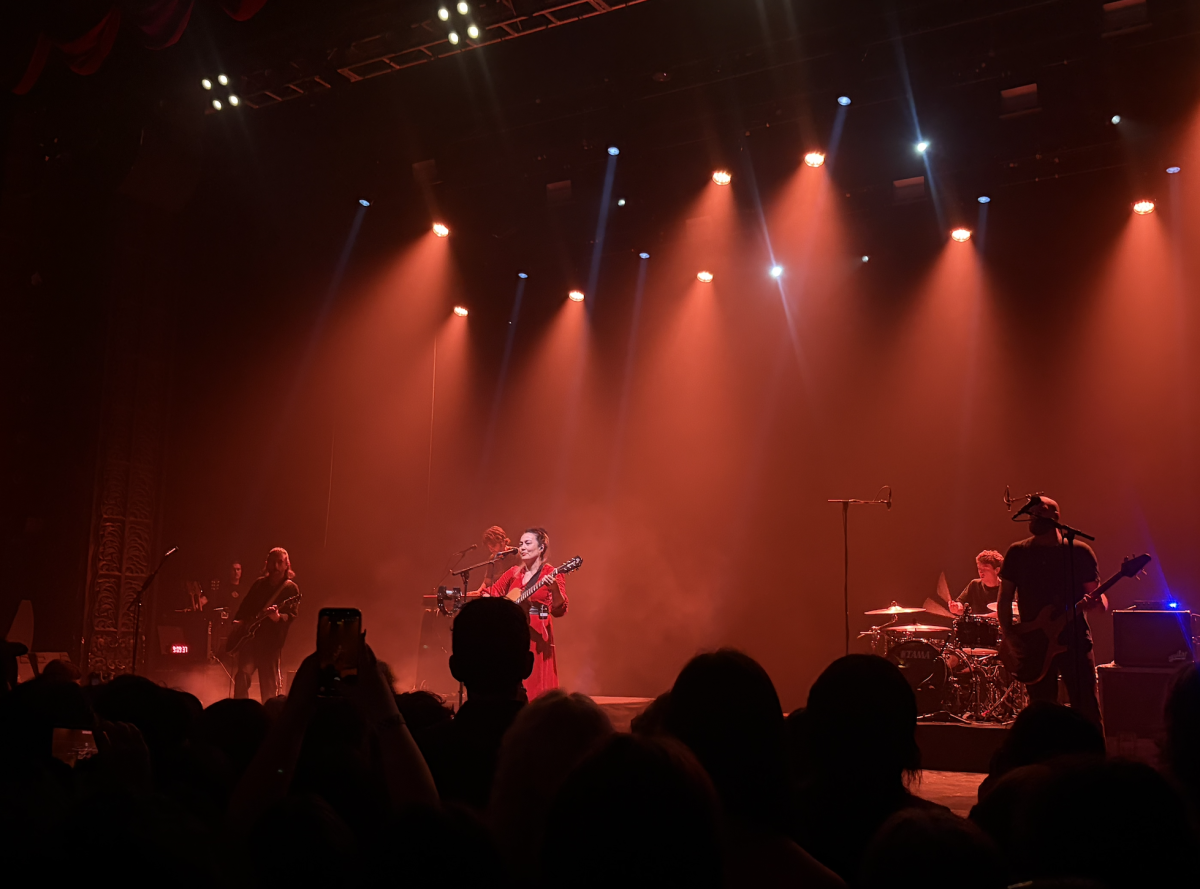
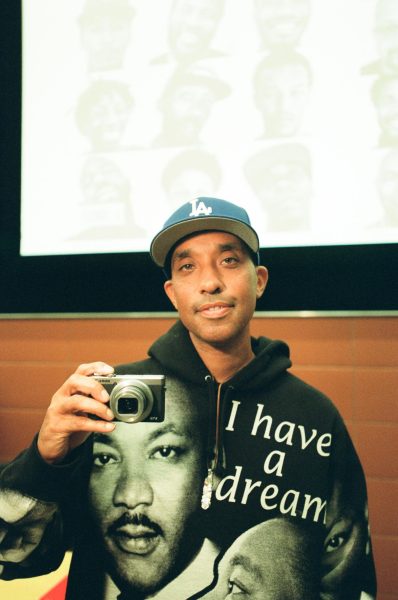
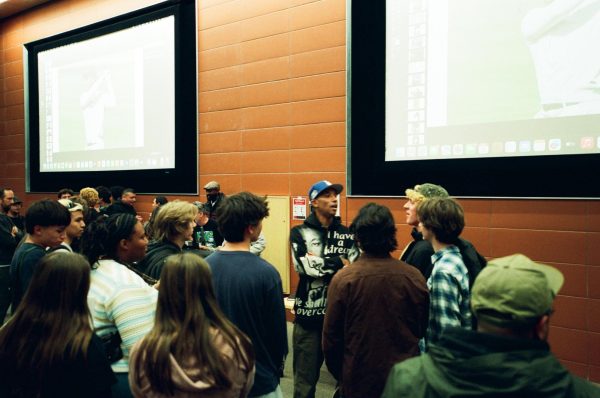
Storm Hall West filled up fast on Feb. 18, as students squeezed into seats next to longtime skaters, photographers and friends, all there for one name: Atiba Jefferson.
The event, “Atiba Jefferson: Finding Focus,” was billed as a conversation and Q&A for Black History Month, but it felt more like a reunion San Diego State happened to host. There was free pizza, water and Tech Decks at the door. The start time slid about 30 minutes past schedule, but nobody seemed to care once Jefferson took the mic.
Even after the final applause, people lingered for nearly an hour trying to snap a photo with Jefferson or get something signed, including skateboards.
Hosted by the SDSU Center for Skateboarding, Action Sports and Social Change and the Gus & Emma Thompson Black Resource Center, assistant professor Neftalie Williams and DGK Skateboards athlete Adrianne Sloboh moderated the night. Williams framed the talk as part of a larger mission: bringing skateboarding into spaces that don’t always make room for it and ensuring Black creatives are centered when it does.
Jefferson’s resume reads like a time capsule of youth culture. He’s photographed icons like Kobe Bryant and LeBron James, as well as artists from Interpol to Turnstile to Tyler, The Creator. He’s also directed the ESPN-produced documentary “Monochrome,” and his client list spans skating, sports, and major brands.
But at SDSU, Jefferson didn’t present himself like a celebrity. He talked like a skater who never stopped paying attention to where he came from.
“I am from a small town in Colorado called Manitou Springs,” Jefferson said. “Picked up a skateboard at 13, and I just fell in love.”
That love turned into a career, not because he was the best skater in the crew, he admitted he wasn’t, but because he found another way to stay close to what he cared about. The camera became his ticket to remain part of the scene without having to land every trick.
(Jose Rizal Mills)
Williams said Jefferson is exactly the type of guest he wanted at SDSU for Black History Month, not just because of the names on his portfolio, but because of what he represents in skateboarding.
“For Black History Month, I wanted to showcase Black excellence in skateboarding across a number of fields,” Williams said. “I’m honored to bring this legendary photographer and director, who works in so many mediums, to campus.”
Jefferson also talked about growing up on food stamps with a single mom, being “checked out” in college except for the darkroom and learning the industry by treating assistant gigs like an education.
“I assisted Andy Bernstein from the Lakers … I treated that like free education,” Jefferson said. “Because I paid attention to what they were doing.”
He also kept circling back to the “do it yourself” spirit of skateboarding, the idea that you fall, adjust and try again until it works. That mentality is part of why Williams argues that skateboarding belongs in conversations about social change, not just sport.
When asked about skateboarding as cultural diplomacy, Williams pointed to a moment that stuck with him: a U.S. State Department virtual summit with young people in Kazakhstan.
“One of the reasons they were interested in skateboarding was because it doesn’t have to function for sport or competition’s sake,” Williams said. “In a context like Kazakhstan, the ability for skateboarding to be a place where people come together to practice, learn from each other, and push themselves — without it being a competition — became something really important.”
Williams said people on the call described skateboarding as a way to feel “complete and connected,” and some said they’d lost that connection after they stopped skating. Hearing those testimonials out loud shifted the room in real time.
“Within that Zoom, we had testimony from skaters who said they wanted to get back on board,” he said. “And instead, it inspired the entire room to want a skateboard.”
That same “not a competition” mindset came up when Jefferson discussed photography, especially shooting skating.
“I will say when shooting skating times, you have to play it safe, because you want to make sure you don’t miss the trick,” Jefferson said. “But if you have the trick and you know you got the photo of the trick, it’s amazing to be able to experiment. I do it every time. If I know I got a good photo, I’m gonna get weird.”
The downside of modern exposure, Jefferson said, is that social media can turn art into a chase for likes, algorithms and timing, rather than point of view. When asked how students can protect their work from being swallowed by that, he didn’t sugarcoat it.
“It’s unfortunate because, you know, the only way to do that is not posting,” Jefferson said. “But it does get us a lot of exposure. So it just depends on what you want to do.”
Williams said part of the center’s work is pushing back on what people assume SDSU is doing when it studies skateboarding at all.
“Sometimes people think we’re focused on teaching people how to skate rather than our actual work,” Williams said. “Which is understanding how the culture of skateboarding can be drawn upon to create social change.”
Ahead of the event, Williams said he hoped students would leave with a sense of authenticity, “showing your true self and forging your own path no matter what the road looks like.”
And judging by the line of people waiting with skate decks, magazines and Sharpies long after it ended, plenty of them were ready to start.