

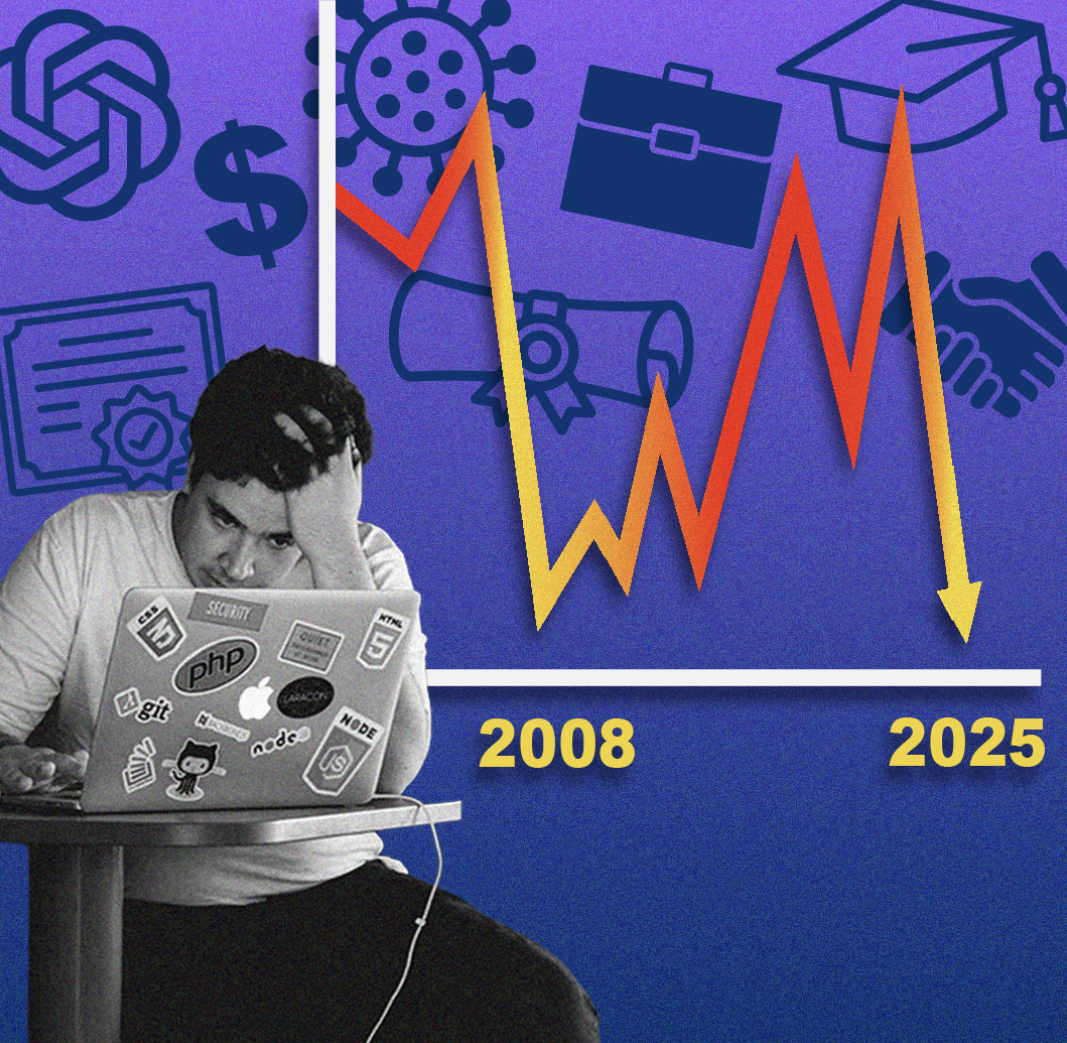
As the corporate job market continues to shift under rapid technological change, Gen Z, those born between the late 1990s and early 2010s, may be facing one of the most unstable employment landscapes since the 2008 financial crisis.
Several economic indicators and expert analyses show that 2025 may be one of the most challenging years for college graduates to secure full-time employment, a trend that is linked to both long-term economic disruptions and the fast expansion of artificial intelligence across industries.
Only 30% of 2025 college graduates and 41% of 2024 graduates found entry-level jobs in their fields, while 48% felt unprepared to apply for such positions, according to Forbes.
COVID-19 has also contributed to an economic slowdown and a decrease in employment
At the same time, increasingly evolved A.I. systems have begun to replace or assist with roles once filled by young workers entering the workforce.
The graduating class of 2026 will be the first to enter the job market after spending their full junior and senior academic years studying alongside tools like ChatGPT, launched publicly in late 2022.
For many students, this has created uncertainty about which skills still matter in a workplace increasingly shaped by AI.
Sarita Cortes, an international economics senior at SDSU who is graduating in May, said the current job market feels discouraging.
“The job market looks terrible. As someone who is graduating, the options I see available look limited,” Cortes said. “All reasonable job listings demand absurd amounts of previous experience. And the jobs that don’t have as many requirements receive thousands of applications by the minute, so it’s very difficult to stand out.”
“It feels competitive and draining,” Cortes said.
According to a CNBC article titled “Why it’s so hard for Gen Z to find a job right now: ‘None of us are really thriving,’” companies are tightening hiring while simultaneously raising expectations for entry-level applicants. The result is a steeper climb for new graduates trying to enter the workforce.
According to data from the World Economic Forum, Gen Z may be experiencing a structural shift in the traditional career ladder, as skills that were once taught in entry-level positions are now expected beforehand in a more competitive hiring environment.
AI tools are eliminating or reshaping early-career roles that once served as essential training grounds for young workers. Many employers justify these shifts as cost-saving measures that improve operational efficiency, reducing the need for large teams.
But, not all students feel assured by this transition.
Viviana Razo, a communication and film student at the University of San Diego, said the rapid expansion of AI technology already feels threatening.
“I think A.I. will become a threat to people and industries in the future,” Razo said.
In addition to technological concerns, Gen Z is also the first generation to graduate after a global pandemic, carrying long-term social and economic anxieties tied to affordability, cost of living and workforce stability.

![Courtesy Photo: Greg Thames [pulled from Pexels website as free use image]](https://thedailyaztec.com/wp-content/uploads/2026/05/Screenshot-2026-05-15-at-11.36.27-AM-1200x820.png)

