“It’s a delicate dance and balance between industry, environmental groups and health,” Paula Stigler Granados said about her role in advocating for change on the California Air Resources Board.
Her work on the California Air Resources Board; a government board that works to protect the public from air pollution, is making progress in finding solutions to the Tijuana River crisis.

This problem affects the San Ysidro and Imperial Beach communities here in San Diego. This problem is caused by sewage flowing from Tijuana into San Diego from the Tijuana River. Paula Stigler Granados is helping to measure the amount of hydrogen sulfide that these communities are breathing in every day.
Stigler Granados is an associate professor in the School of Public Health. Having obtained her master’s and doctorate degrees from SDSU, and after six years in the field, she came back to SDSU to work on her research and teach.
She is the division head for environmental health and an expert in transborder environmental health and Chagas disease. She defined Chagas disease as a parasitic infection that is spread to humans and animals through a bug known as the kissing bug [Triatoma Sanguisuga].
Her Work
In 2024, Stigler Granados started working on the Tijuana River crisis, measuring the amount of hydrogen sulfide in the air. She stated that it is a transboundary infrastructure failure and justice problem.
“What makes it a crisis is that the communities bearing the worst of it are predominantly low-income and communities of color,” she said. “They didn’t create this problem. They’re just the ones breathing the toxic gases and living in the contamination.”
Fixing this problem isn’t simple. Stigler Granados stated that investment is needed on multiple levels.
“Infrastructure on the Mexican side — the treatment plants and the collector systems — needs serious capital and attention,” she said. “The International Boundary and Water Commission needs resources and accountability.”
It’s not just Mexico that needs to be held accountable, she said; the U.S. also needs regulatory updates.
“We do have monitors and a warning system [for the sewage levels], but it’s not enough and right now it’s human-powered: Someone has to see the data, make a call and send an alert. When hydrogen sulfide levels spike at 2 a.m., that lag time matters,” she said.
Hydrogen sulfide can be dangerous if high levels of it are breathed in. According to the Occupational Safety and Health Administration, long-term exposure to hydrogen sulfide can cause nausea, watering eyes, headaches and sleep loss. Prolonged exposure to high levels of hydrogen sulfide can cause loss of smell, conjunctivitis, respiratory problems and pulmonary edema (fluid in the lungs).
Stigler Granados stated that the Air Pollution Control District is trying to automate the process so that communities can get real-time alerts when the levels exceed health benchmarks. However, support is also needed at the state and federal levels.
The Crisis
The Tijuana River crisis has been going on for decades. In the past two years alone, there have been many efforts to find solutions to the ongoing problem.
In 2024, former President Joe Biden signed a federal bill for $250 million to be allocated to fixing the South Bay International Wastewater Treatment Plant on the U.S.-Mexico border. This treatment plant helps to clean the sewage before it flows into the river.
In November 2025, a storm caused the Tijuana River to flood Imperial Beach, according to KPBS.
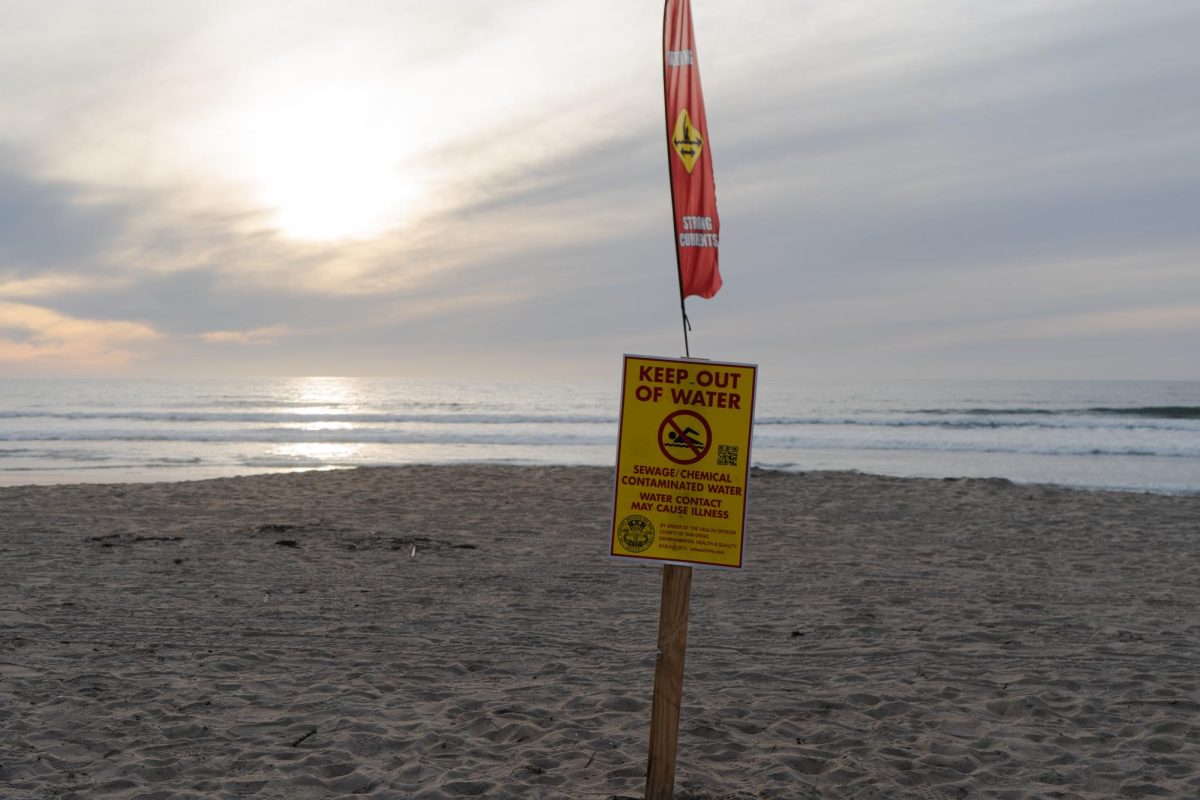
Imperial Beach is currently closed because bacteria levels exceed a healthy level, according to San Diego Coastkeeper. As of 2024, Imperial Beach had been closed for over 1,000 days. Just a few miles north, Coronado has an advisory for Glorietta Bay, North Beach, Lifeguard Tower and Avenida Lunar; and Silver Strand shoreline is currently closed.
In January of this year, San Diego County supervisors voted to fund an air purifier distribution program and epidemiological study, taking a step forward both in the short-term and long-term fix for this problem.
On April 26, San Diego County Supervisor Paloma Aguirre asked Gov. Gavin Newsom to declare a state of emergency over the problem. According to CBS 8, the San Diego County Board of Supervisors has declared a local state of emergency 22 times since 2018.
Since Stigler Granados started working on the Tijuana River crisis, she has experienced the problems the community faces firsthand.
“I had been really sick after doing a lot of sampling at the river,” she said. “Prolonged exposure to high levels of pollution and contamination during the height of the crisis in 2024 made me very sick. Subsequently, I ended up losing my kidney due to an antibiotic-resistant infection.”
Support in the Community
Stigler Granados said that there are some things the San Diego community can do to help fix this problem.
The best way to have your voice heard, she said, is by showing up to the Air Pollution Control District board meetings and County Board of Supervisors meetings, which are public forums.
“These decisions about monitoring, funding and enforcement happen in public forums where community voice matters.” Stigler Granados said.
Another way to help out is to support the organizations working on the problem. Organizations like the Tijuana River Coalition, Surfrider, Coastkeeper and the community groups in San Ysidro are all working to make people more aware of the Tijuana River crisis.
Stigler Granados stated that in the next year, she hopes that progress is made on the monitoring infrastructure and that conversations on funding persist at the state and federal levels.
“I don’t expect the underlying contamination to improve dramatically; that requires years of construction and political will that still feels fragile,” she said. “The research is there. The community is organized. What we need now is for decision-makers to act like this is the emergency that it actually is.”