


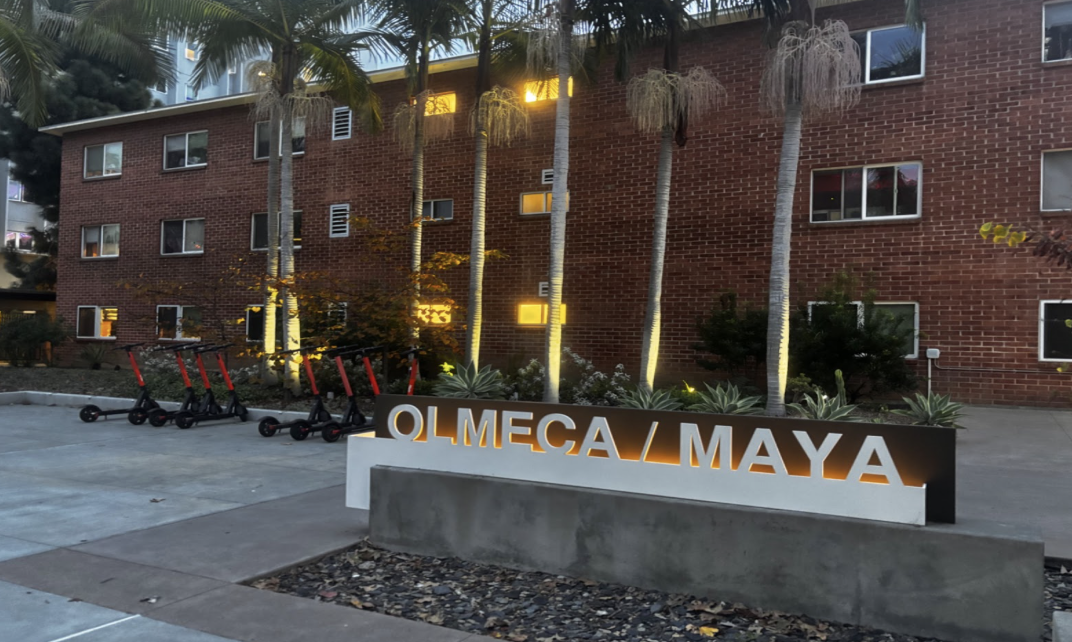
Since 2022, first-year enrollment at SDSU has rapidly increased, with the university breaking its record of admitted students by welcoming 6,745 freshmen for the fall 2025 semester.
With the requirement that SDSU first-year students outside of the local admission area must live on campus, and with the increase in enrollment, student housing availability over the last few years has been limited, leading SDSU to increase room capacity in first-year dormitories and begin new housing projects.
Privacy is scarce
According to SDSU’s Accommodations website, most dorms are 11 x 15 feet, which equates to 165 square feet for a double bedroom. With the addition of an extra bed, desk and wardrobe to convert the dorms from doubles to triples, personal space is harder to come by.
First-year student Lauren Hommertzheim, who currently lives in South Campus Plaza, had to adjust during her first few weeks at SDSU from having her own room to sharing a room with two other girls.
“I can ask the roommate that I like for some time alone, but not the other one,” Hommertzheim said. “So it’s really difficult being able to feel 100% comfortable in my space.”
As an out-of-state student from Colorado, Hommertzheim said the lack of personal space and communication within her dorm has also made her feel more homesick.
For students like Emma Cantillon, a junior at SDSU, experienced the tight squeeze of the dorms and says finding an off-campus space is like heaven.
Living in Maya and Toltec her first two years on campus, Cantillon said she was surprised how she managed to live in what she described as a “shoebox space,” compared to her two-bedroom apartment she now lives in at The Rive, an off-campus student apartment complex.
“I always say this like half joking, but it’s inhumane conditions in those dorms sometimes,” Cantillon said. “Three people are not meant to live in that one tiny little space.”
Cantillon also recalled having almost a year-long battle with mold while living in Toltec.
Initially catching it in her bathroom, she recounted herself and her roommates attempting everything possible to remove it. However, with four girls sharing a bathroom, minimal ventilation, she explained how they were no match for the mold and it never went away.
“We called maintenance, we reported it, and they basically said there’s nothing they can do. So we were forced to live with that for nine months,” Cantillon said.
Now at The Rive, Cantillon said she has not faced any issues with mold or other maintenance difficulties.
Housing costs continue to climb, while living spaces shrink
As students continue to live in tight quarters and enrollment numbers have increased by 11.6% in the last four years, annual on-campus housing prices have also gone up.
According to the Office of Housing Administration, the lowest price for a triple or quad room, including a meal plan, was $19,653 for the 2024-2025 school year, which is paid in four installments per semester. For 2025-2026, that cost rose by 3.6%.
“I think [SDSU] knows they can get away with charging so much for them, because the prices for those dorms, even though you’re living in a tiny, little triple apartment, is obscene and insane,” Cantillon said.
Sophomore Kaitlyn Fernandez, who resided in University Towers during the 2024-2025 academic year, said she did not see her housing money going towards amenities in her dorm building.
“It [housing payment installments] was $1,900 a month, which I think is ridiculous and I didn’t really see that money going towards the facility we lived in,” Fernandez said.
Unlike other freshman dorms, Fernandez said University Towers has zero communal spaces for students to study in and found using the elevators inconvenient. With only two elevators in a nine-story building, she often faced difficulties catching an elevator, making her late to class or having to take the stairs.
Similar to Cantillon, Fernandez said maintenance was slow when it came to addressing hygiene issues in UT — except Fernandez’s encounter wasn’t mold.
“It was really gross a lot of the time, like people would throw up in the elevators and it would just sit there forever,” Fernandez said.
The Office of Housing Administration did not respond to requests for comment about overcrowding, dorm conditions and increasing housing prices.
SDSU embarks on multiple housing projects
While the Office of Housing Administration has not directly addressed the reported issue of overcrowding in the dormitories, the campus has begun multiple projects to increase availability for students to live on or near campus.
The Evolve Student Housing project is one of two projects currently in the works that began construction this summer.
According to SDSU’s Housing and Residential Education, the project is multi-phased and will bring seven new dormitories to the campus. One tower on Montezuma Road and six towers on 55th street that will replace several of the aging “Tecs” buildings.
The plan, released by the Housing and Residential Education, also stated that phase one is set to be completed by mid-2026 and open to students beginning in the fall 2026 semester. The newest building, currently titled Texcoco, will add approximately 650 beds to on-campus housing,
The Housing and Residential Education also stated that phases two through four of the Evolve project have yet to be approved by the California State University Board of Trustees, meaning the expansion of on-campus housing is still not guaranteed.
Additionally, SDSU has partnered with Avalon Bay Communities to bring more off-campus housing in the Mission Valley Area. Set to be finished by 2028, the project will render a new development east of Snapdragon Stadium and will create space for 621 apartments, according to a statement released by SDSU.
However, despite these plans, students could potentially wait years, and must continue to adjust to their environments before a change is seen.
“I just think there needs to be a better system when it comes to dorm spaces, and hopefully they’ll [SDSU] change it,” Hommertzheim said.
Editor’s note: This story has been updated to reflect accurate housing language.

![Courtesy Photo: Greg Thames [pulled from Pexels website as free use image]](https://thedailyaztec.com/wp-content/uploads/2026/05/Screenshot-2026-05-15-at-11.36.27-AM-1200x820.png)
