


Student leaders running in the upcoming Associated Students elections at SDSU are campaigning on a common set of issues affecting campus life, including rising housing costs, financial transparency and access to academic resources.
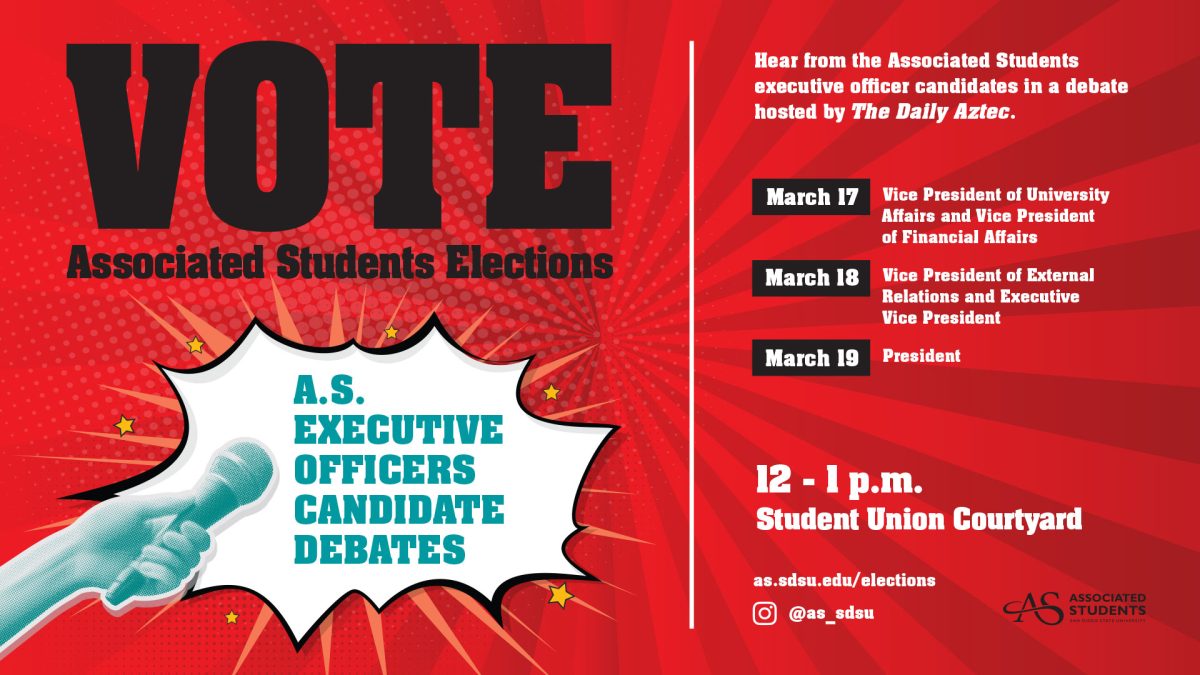
Debates for the presidential position and the four vice president positions will take place from March 17-19, and voting will be open for all A.S. positions from March 23-26.
The election will determine five executive leadership positions within A.S.: President, executive vice president, vice president of external relations, vice president of financial affairs and vice president of university affairs.
The annual election will determine the next slate of A.S. executive officers to represent student interests in university decision-making and at the broader California State University system level.
Four candidates are running for A.S. president: Julia Biesman, Mohamed “Mokat” Erekat, Isabella Marie Martinez and current Executive Vice President Milan Rawls
The race for executive vice president includes Andy Jose Lopez, Chloe Beseke, Jasmine Vu and Jacie Foster. Three students are competing for vice president of external relations: Jamie Quach, Celina Ramirez and Scarlett Walker. The vice president of the financial affairs race includes Michael Moyer, Jake Camacho and Eric Krog. Two candidates, Noah Abushadi-Stuart and Jhacob Blenman, are running for vice president of university affairs
While candidates come from different student organizations and leadership backgrounds, several shared themes have emerged across their campaign statements and early debate discussions: rental affordability in the College Area, improvements to academic advising, more transparent financial systems within A.S. and stronger representation for student groups.
Concerns about housing affordability
Housing costs in neighborhoods surrounding SDSU surfaced as a central campaign issue, reflecting concerns many students have raised in recent years.
Presidential candidate Milan Rawls said her platform prioritizes advocating for more affordable housing near campus.
“As President, I will advocate for affordable housing in the college area,” Rawls said in her campaign statement.
Scarlett Walker, a candidate for vice president of external relations and current A.S. chief justice of the Judicial Affairs Council, also highlighted housing affordability as a key concern, particularly as the university continues development projects such as Evolve Student Housing.
Walker said she hopes to push for stronger student oversight to ensure transparency in housing developments that affect campus living conditions.
Transparency in student government finances
Another major theme among candidates is increasing transparency around how A.S. manages its financial resources.
In particular, candidates running for vice president of financial affairs emphasized improving communication about student organization funding and simplifying the current A.S. banking system.
Candidate Eric Krog, a computer science and economics major, said he hopes to modernize financial processes by combining resources and banking tools for student organizations into a centralized digital platform.
Jake Camacho, who currently represents the College of Engineering in A.S., proposed launching a monthly email campaign to inform students about financial changes and updates.
Michael Moyer, another candidate in the VP of financial affairs race, said he plans to work closely with the university’s Economic Crisis Response Team to help students access financial resources and basic needs support.
Academic advising
Academic advising and course accessibility also appeared across several campaign platforms.
Jhacob Blenman, a candidate for vice president of university affairs, said he plans to work with academic advising offices to increase accessibility and help students navigate their path to graduation more efficiently.
Noah Abushadi-Stuart, the other candidate in the race, said his campaign focuses on improving campus safety and expanding career readiness initiatives to ensure students feel supported.
Other candidates also support the need for clearer communication about academic resources, as well as improved access to courses required for degree completion
Representation matters
Representation of diverse student groups, including multicultural fraternities and sororities, was another issue raised.
Some candidates emphasized the importance of ensuring that all student organizations feel included in university decision-making and receive equitable access to resources.
Isabella Marie Martinez, a presidential candidate involved in multiple campus organizations, said strengthening connections between A.S. and the broader student body is central to her platform.
“My mission is to strengthen campus connections and empower every student to lead with confidence,” Martinez said in her statement.
Similarly, executive vice presidential candidate Jasmine Vu said she hopes to create more initiatives that foster community and belonging, particularly for students who may feel overlooked within the campus system.
“No student at SDSU should feel invisible, overwhelmed, or alone,” Vu said in her statement.
A series of candidate debates are scheduled for next week, leading up to the election from March 23-26, allowing students to hear directly from candidates about their priorities and proposals.

![Courtesy Photo: Greg Thames [pulled from Pexels website as free use image]](https://thedailyaztec.com/wp-content/uploads/2026/05/Screenshot-2026-05-15-at-11.36.27-AM-1200x820.png)
