

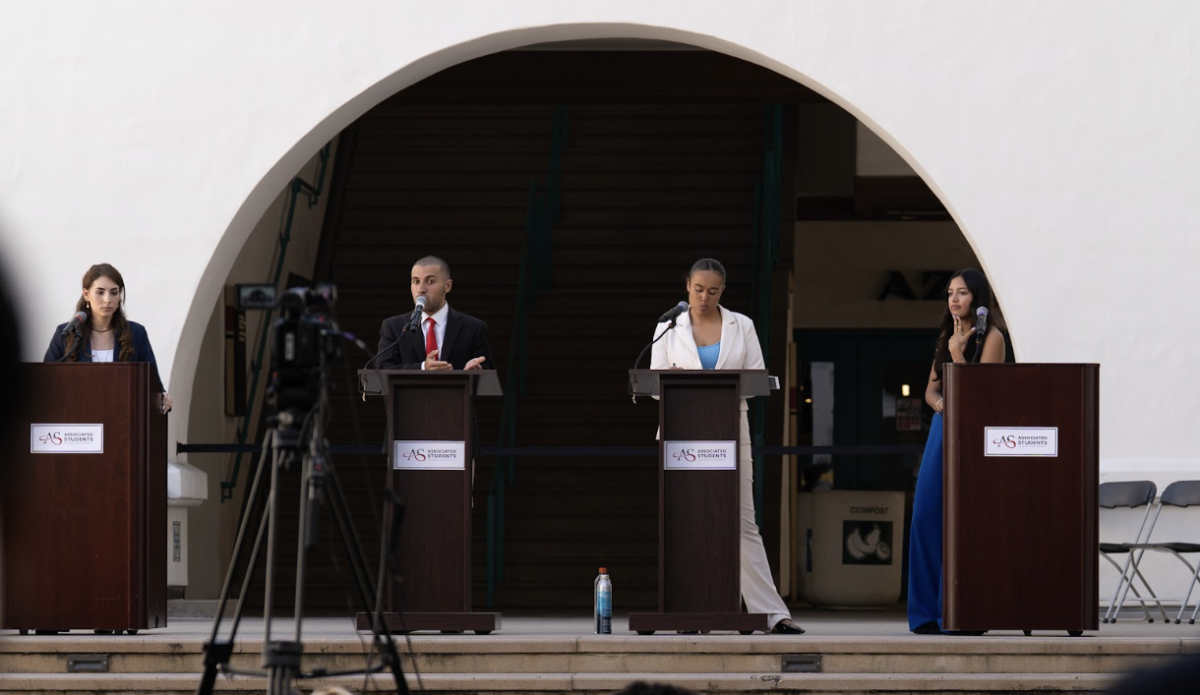
The Associated Students debates were capped off with presidential candidates engaging in a heated discussion that drew a vocal crowd in the Conrad Prebys Aztec Student Union Courtyard on March 19.
The issues candidates argued over included affordability for students, transparency in A.S. actions, the role of an A.S. president and the organization as a whole.
The role of an A.S. president is to act as the primary voice for the student body in discussions with SDSU’s administration and faculty, oversee official decisions made by the A.S. Board of Directors and set priorities for the entire student government.
Julia Biesman, Mokat, Milan Rawls and Isabella Marie Martinez are the running candidates for A.S. president.
Biesman, a third-year Board of Directors member, centered her statements around the promise of transparency to all students and the willingness to take action rather than simply promise changes.
“I am a vessel for the students and I hope you know that I care for you. Each and every one of you,” Biesman said.
Rawls, the current executive vice president of A.S., emphasized her experience within the A.S. body, the relationships she has built throughout her time and her desire to make SDSU a more affordable school.
“I am here to continue the work that I’ve put into my executive vice president term and I am here to continue amplifying the student voice,” Rawls said.
Martinez, a representative for the Campus Community Commission, vowed to educate the student body about what resources are available to them, embrace the opinions and needs of a diverse population of students and empower the voices of students outside of the A.S. body.
“If students don’t know what Associated Students is, change can’t be made because we can’t hear their voices,” Martinez said.
Mokat ran an unorthodox campaign with a simple candidate statement stating “MOKAT. MO Impact. No Drama. No Act.” During the debate, he focused on the lack of follow-through from current A.S. members, promised to hand out his entire presidential salary as scholarships and stated that he would avoid re-appointing the same members to the same position.
“What students want is what Associated Students’ values should be. There should not be a difference in them. Right now we have a difference because Associated Students does not serve the student body. Associated Students serves what the administration wants,” Mokat said.
Mokat also recounted a Board of Directors meeting during which he denounced the genocide in Gaza, asserting that, when he was silenced by SDSU’s administration, his fellow candidates failed to stand in solidarity with his statements.
The three other candidates said that they respected his right to express his opinions and that their silence didn’t equate to opposition.
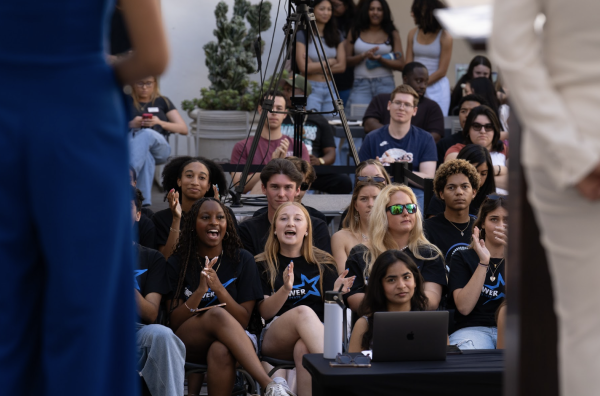
Due to her currently holding the position of executive vice president, Rawls faced criticism from her fellow candidates about the actions taken during her current term. Biesman argued that Rawls lacked a concrete plan to improve housing affordability, while Mokat and Martinez claimed that Rawls didn’t do enough during her term as executive vice president to justify her election as A.S. president.
Rawls rebutted against her opponents, asserting that the experience and status she has gained as executive vice president make her the most qualified candidate. She referred to the statements against her as “non-presidential.”
The debate capped off with closing statements centered around student representation, transparency in A.S. actions and strong pushback against SDSU administration.
Voting for all A.S positions starts on March 23 and ends on March 26 at 7 p.m.


![Courtesy Photo: Greg Thames [pulled from Pexels website as free use image]](https://thedailyaztec.com/wp-content/uploads/2026/05/Screenshot-2026-05-15-at-11.36.27-AM-1200x820.png)
