Student leaders passed two resolutions last week, condemning both the federal government’s immigration policies and the university’s recent choice to increase tuition without a student vote.
Additionally, the Associated Students University Council worked to amend an unnamed resolution aimed at defining the Israel-Hamas war as “the genocide against the people of Palestine,” and having both A.S. and the university “publicly acknowledge their historic complicity in student censorship and platforming of hate speech.” A vote on this resolution will take place on April 22.
The majority of the debate during the meeting revolved around the use of the term “genocide.” The resolution also includes demands such as: SDSU must sever ties with the Murray Galinson San Diego-Israel Initiative, a program that aims to build academic Israel content and engagement on local San Diego university and law campuses, ensure transparency for donor and partnership agreements, halt funding for non-relious-related study abroad trips in Israel, and a university statement of support for Palestinian, Arab, SWANA and Muslim students.
Ari Cohen, student representative of the College of Professional Student and Fine Arts, argued that the resolution’s use of the word “genocide” is antisemetic.
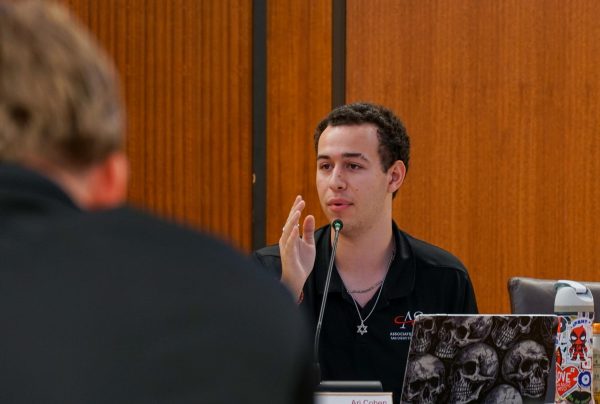
Cohen instead proposed an indefinite delay of the vote and the creation of an ad hoc committee to include students from “every single involvement in terms of this conflict.”
“It would be much better to start those conversations in that committee than argue about them on this floor,” he said.
13 students gave public comments during the allotted time, both supporting and criticising the resolution’s specific and overall demands.
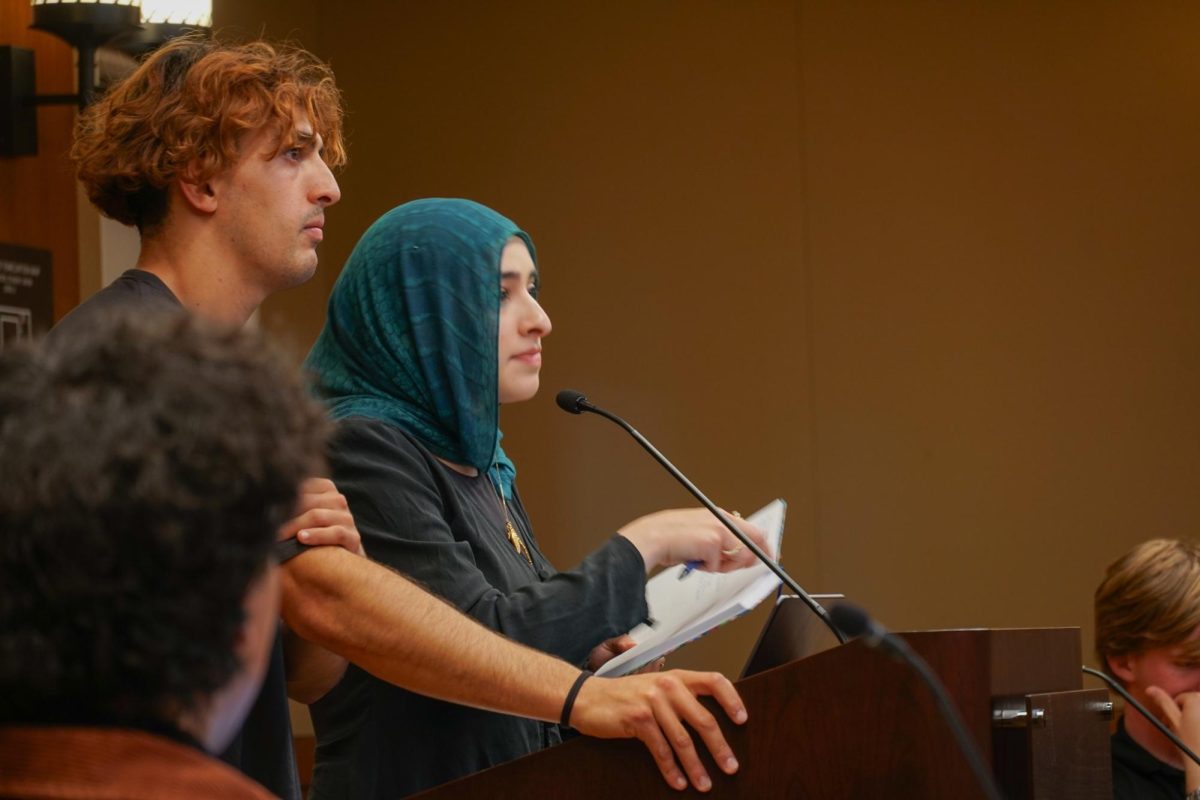
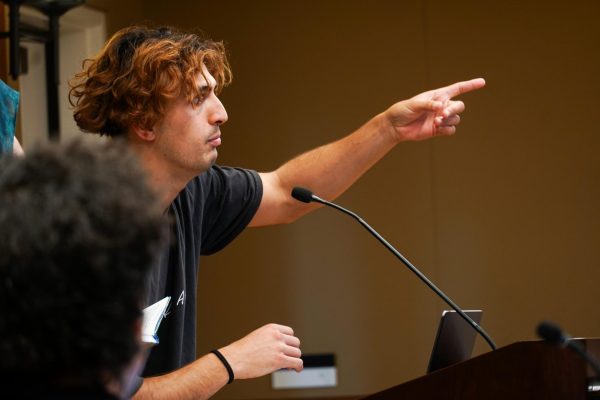
Yucef Bouzina, one of the authors of the resolution and A.S. Student Diversity Commission representative said that he knew this resolution was going to be hotly debated, but holds to the explicit use of “genocide” in the resolution.
He said that it is part of his job to represent student diversity to the best of his ability, even with his own biases as a Muslim student.
“I am pushed into a very delicate, bureaucratic role where I have to represent the interests of my student diversity commission and also the interests of my identity and my community, my religious community that I identify with,” he said.
He described himself as someone with stakes in the conflict, and acknowledged the relationship between his role and his opinion.
“It is my duty, really, as the Student Diversity Commission representative, to represent both of those groups’ interests,” he said. “However, I will, as a human being with ethics and morals, I will never stand behind somebody who supports a genocide, and that extends past my role as Student Diversity Commission representative.”
The resolution further called for accountability from the state of Israel, stating that accountability “entirely separate from adopting an anti-Semitic prerogative.”
Former University Council representative Maya Gerassi doesn’t believe the resolution is bipartisan.
“It’s not representing all students in the way they feel, which is evident in the meeting today,” she said. “It doesn’t represent the rest of the students that spoke, who aligned with me today. So I think that that’s a big reason that we’re out there speaking, because we are feeling, so one side is trying to heal from this resolution and another side is feeling targeted by the resolution, which means that the resolution is inherently flawed.”
Gerassi supported Cohen’s proposal for an ad-hoc committee, which was voted down during the meeting.
She said that creating a space for students to bring forth different perspectives would be much more productive than passing a “one-sided resolution that has one side is on the offense and one side is on the defense.”
“What if there was a room where all of our voices could be heard outside of fighting over resolutions?” Gerassi asked.
In the interest of time, A.S. President Kareen Holstrom made a motion to adjourn the meeting and pick up the discussion again either during a special meeting or at the next scheduled ASUC meeting on April 22.
The April 22 meeting is the deadline for the ASUC to vote on the resolution. Even if voted on before that date, the council will still have the opportunity to make last amendments.
Editor’s note: This story has been updated to reflect accurate information.