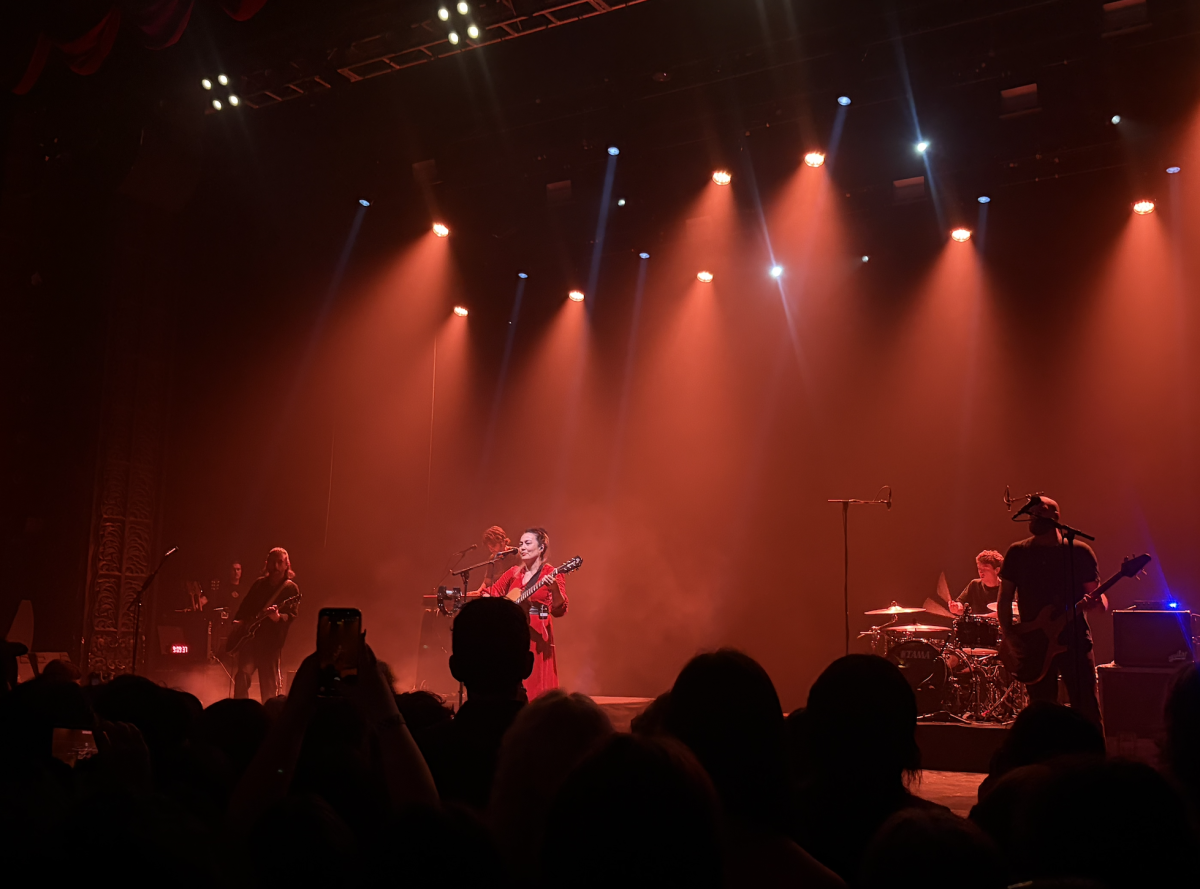
Charlie Puth opened the first night of his “Whatever’s Clever” World Tour in San Diego at Viejas Arena with a performance that balanced his technical precision, humor and emotional honesty, setting the tone for a night that felt both intimate and arena-sized.
The evening began with rising artist Ally Salort, who quickly transformed the arena into a glowing, participatory space. One of the first songs she performed, “We’re Not Friends,” started off quietly, but the atmosphere shifted as audience members began raising their phone flashlights, illuminating the venue.
Salort also played an unreleased track, “Housekeeping,” giving the crowd a preview of her new material. By the time she reached “Deeper Meaning,” the audience was fully engaged, singing along as the arena filled with a chorus of voices, turning her set into a shared, immersive moment.
Daniel Seavey, the second opener for the night, followed with a more experimental, stripped-back set. Starting solo, he later incorporated a violin into one of his slower songs, prompting the crowd to sway in unison.
Leaning into improvisation, he used a looper and even asked the audience what to play next, launching into a spontaneous rendition of “One Less Lonely Girl,” by Justin Bieber. An unreleased violin piece further showed his musical talent, as he layered melodies live while the audience clapped along.
By the time Puth took the stage, the energy had fully built. As the first stop on the tour, the performance carried a sense of excitement and spontaneity. He started off joking about being a new dad and poking fun at his outfit, but still delivered a tightly crafted show.
The setlist was balanced, featuring his biggest hits with underrated songs, particularly from “Voicenotes,” rewarding longtime fans. Songs like “LA Girls,” “Empty Cups” and “Suffer” showcased his range, while “Attention” and “We Don’t Talk Anymore” drew some of the loudest reactions of the night.
When the opening notes of “See You Again” hit, the crowd erupted, turning the arena into a full-scale sing-along.
As the night went on, the energy in the arena only intensified, so much so that the show ran past its scheduled end time. Originally set to wrap at 10:30 p.m., the concert stretched nearly 20 minutes longer, ending closer to 10:50 p.m.
Rather than rushing offstage, Puth acknowledged the delay with humor, joking that the crowd was so loud he was willing to push back the curfew.
Between songs, Puth repeatedly encouraged the audience to take inspiration from the night and create something of their own. Whether it was writing a book, recording a song or making a film, he emphasized the importance of acting on creative impulses.
He emphasized to “ignore the noise” and make art anyway.
Miguel Naratis came to the show with his girlfriend, an SDSU student, who scored a last-minute ticket, and said he was excited to finally see Puth live after following his earlier work. “I’m actually a big fan of his debut and his old songs,” he said.
Emily Cabral, a senior and attendee of the concert, described both Puth and Seavey as “pivotal artists” in her early life. “They’re very uplifting,” she said.
Collette Shaikhvand, also a senior and attendee of the concert, said that while “Attention” was initially a favorite, “One Call Away” ultimately stood out the most.
“It was so good,” she kept emphasizing.