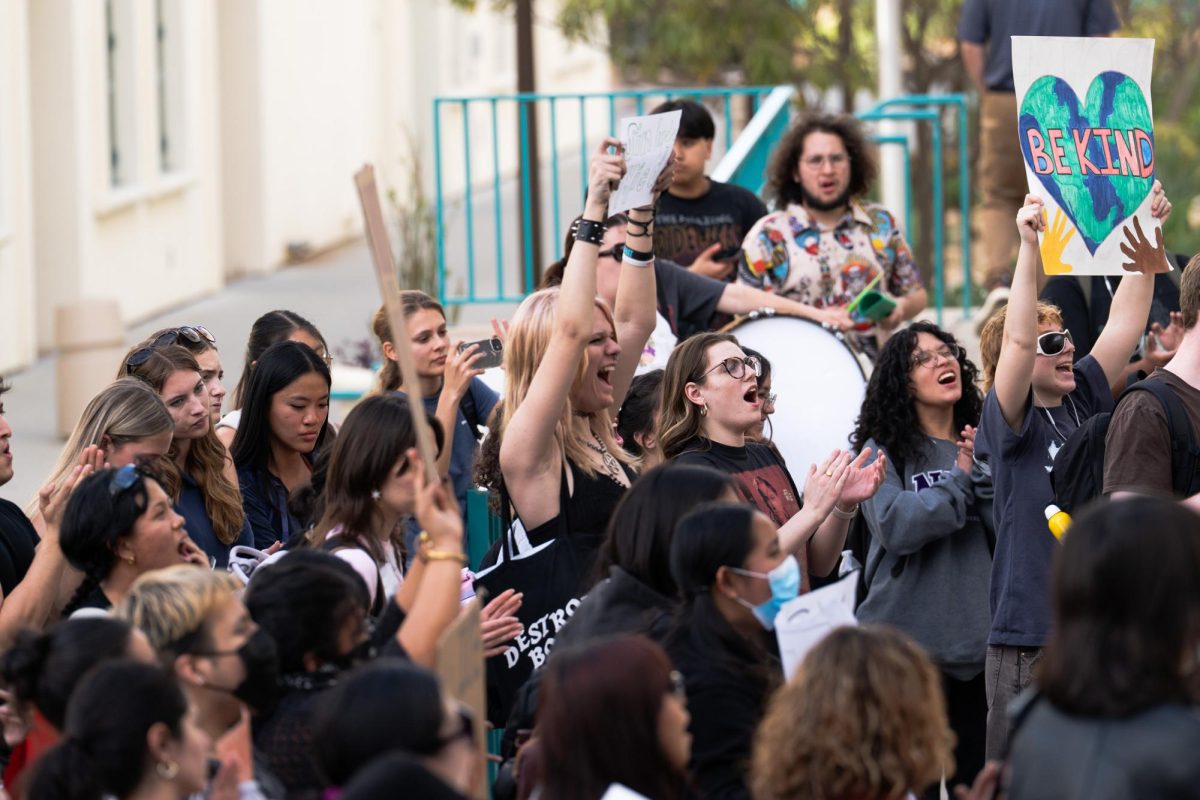
On Thursday afternoon, the Movimiento Estudiantil Chicanx de Aztlán (M.E.Ch.A.) held a protest calling for the abolishment of U.S Immigration and Customs Enforcement (ICE). The protest was announced Wednesday on the student organization’s Instagram page, along with a list of demands directed at San Diego State University.
The protest came in response to events in Minnesota, as videos have circulated on social media showing multiple ICE-involved shootings that resulted in the deaths of at least two U.S. citizens and uproar across the nation.
Students made their demands to the university clear during the three-hour protest: safety and protection for undocumented students; staff training in the event of ICE agents coming to campus; transparency through a mass notification system; and increased scholarships and opportunities for undocumented students.
Victor Hernandez Bustos, who initiated and led the protest alongside M.E.Ch.A. Co-Chair Karla Chaj-Perez, chanted as students gathered around Hepner Hall holding signs and flags.
“Wake up! The students are out here and demanding for more,” Hernandez Bustos said to the crowd. “Our president is actively ignoring us, ignoring our demands.”
Although SDSU has been a designated Hispanic-Serving Institution since 2012, members of the Latinx student community still feel their concerns continue to go unheard amid increased ICE raids and the current political climate.
“As a Hispanic-Serving Institution, it is their responsibility to make sure that their Hispanic students are seen,” said Alyssa Rodriguez, M.E.Ch.A. co-vice chair. “To make sure that they have resources in a time where Hispanic and Latino students are being attacked.”
Protesters marched from Hepner Hall to the Conrad Prebys Aztec Student Union, located next to the office of SDSU’s President Adela de la Torre.
During the protest, students held the president accountable for her silence on ICE activity in San Diego. M.E.Ch.A. Co-chair Salma Lopez expressed her thoughts.
“That email you sent is not enough,” Lopez said, referring to the campuswide ICE policy email sent on Jan. 28. “We expect so much more from you, and it’s very essential that you take action now, be transparent about what’s happening within the president’s office and transparent with how you’re going to help undocumented communities.”
Though students fear consequences for speaking their minds, many are using their privilege to speak up for those who cannot.
“It’s really horrible. I’ve been scared to protest because I don’t want to get killed,” said Siena de Leon, a second-year psychology major. “I grew up on diversity, knowing that we are a nation of all different kinds of people and we don’t discriminate towards them.”
Students stood in solidarity with Minnesota, where protesters have been targeted by ICE agents for supporting their communities.
“I feel disgusted that America is doing this, that we’re allowing ICE to just kill people, murder people on the streets,” said first-year student Alyssa Thompson. “It’s a genocide that’s happening and it’s targeting people of color.”
Over the course of the protest, multiple students and campus organizations presented their concerns through prepared speeches and performances. Chaj-Perez stood before the crowd and sang the well-known Mexican anthem “El Rey” by José Alfredo Jiménez as a symbol of hope.
Students also expressed their desire to attend classes without worrying about being detained or deported.
“This is education,” said Adrian Murguia, a third-year finance major. “This is not a place where you conduct an unconstitutional thing such as what’s going on right now in the U.S. It’s just not right, and especially here. All we want to do is learn.”
The crowd grew as organizers brought students together to represent SDSU’s Latinx community and embody the advocacy that M.E.Ch.A. stands for.
“It’s terrifying that it feels like our own school is betraying us, along with our own country,” said Murgia.
Organizers made it clear that they will continue to stand up and speak out until the university makes a change.
“This is not the last protest we’ll have,” said Chaj-Perez. “This will be far from the last because the institution wants to see us quiet. We shall not stay quiet.”

![Courtesy Photo: Greg Thames [pulled from Pexels website as free use image]](https://thedailyaztec.com/wp-content/uploads/2026/05/Screenshot-2026-05-15-at-11.36.27-AM-1200x820.png)