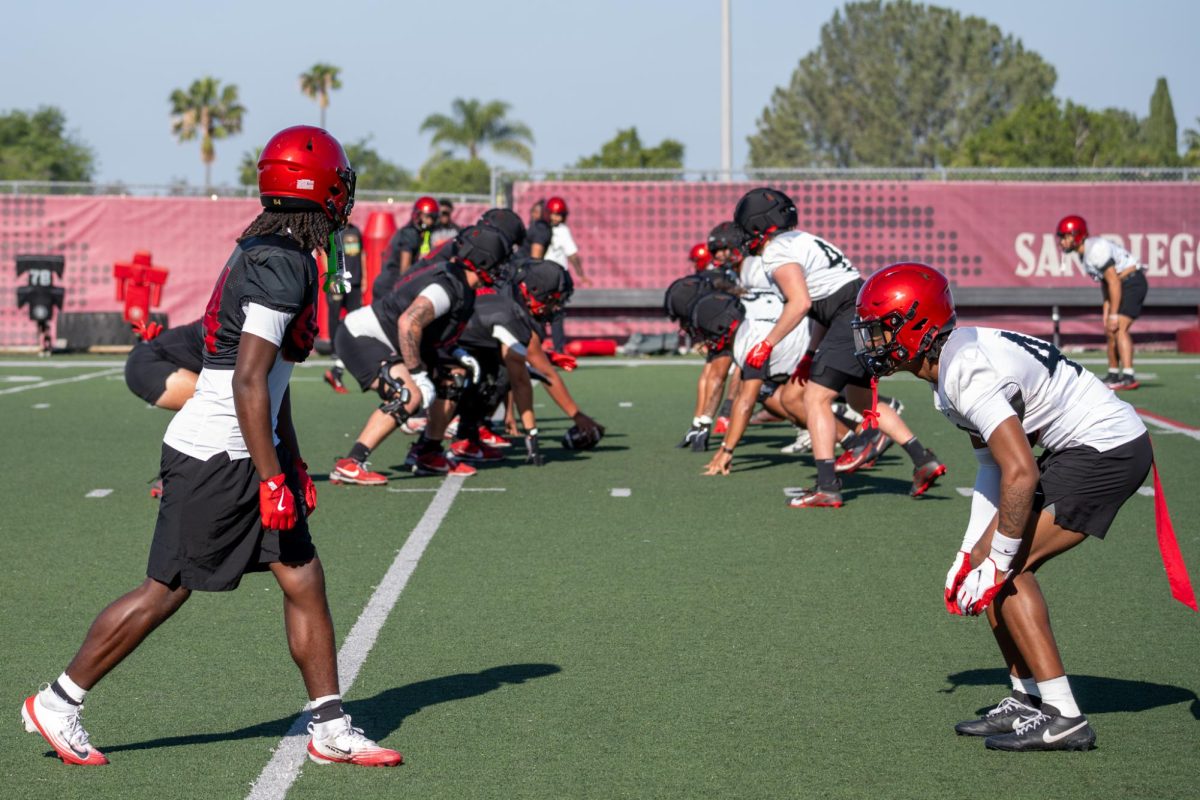
While the San Diego State Aztecs’ (7-2, 4-1 Mountain West) passing and receiving numbers are not necessarily lighting the college football world on fire, the offense’s efforts through the air have created a more solidified identity that was absent in recent seasons.
Matt Johnson is in his first year as offensive coordinator for the Aztecs, but he is very familiar with the requirements of an efficient passing game. He spent his collegiate football career at Bowling Green, setting the school record for career passing touchdowns (73) and earning 2015 Mid-American Conference (MAC) Player of the Year honors.
During Johnson’s decorated 2015 season, he worked alongside one of his then-offensive coordinators and quarterback coach, Sean Lewis, who is now the head coach of SDSU football.
Since 2015, Johnson and Lewis have become inseparable, coaching together for eight of the last nine college football seasons. Their deep-rooted relationship is one of the many reasons why the Aztecs’ passing attack has been so lethal through the team’s first nine games.
“At this point, we are pretty much speaking the same language,” Johnson shared. “The thing that helps is when [we are communicating] with the quarterbacks or the receivers, we are speaking the same language, which I think builds that continuity throughout the whole unit.”
Michigan transfer and SDSU starting quarterback Jayden Denegal is an immediate benefactor of Johnson’s and Lewis’s “continuity,” as the junior signal caller has never started in his college career.
“Those guys have been locked in for a while,” Denegal said. “Coach Lewis was [coach Johnson’s] offensive coordinator at one point, and now both of those guys are my coaches. I just continue to learn from both of [their] experience and knowledge that they have.”

As Denegal became more comfortable with coach Johnson’s offensive scheme, he brought his pass catchers with him. Wide receivers like Jordan Napier, Donovan Brown, Nathan Acevedo and Jacob Bostick have brought a certain level of depth and playmaking that some past Aztec offenses would dream about.
“I think the biggest thing [that this offense has] is the guys that we have out on the edge,” Johnson explained. “Guys that are new, like [Acevedo], have done a great job for us. There is still a lot of room to grow in the throw game with so many new faces we are working with this year.”
When Denegal arrived from Ann Arbor, he had to establish chemistry with his fellow transfers, like Bostick (Texas A&M), Acevedo (Fresno State) and Brown (Monroe University). Seemingly, the group’s connection is well-established, thanks to countless routes and dropbacks.
Like the transfer wide receivers, Denegal also had to adjust to the transfer tight ends and running backs — a crucial part of Johnson’s unit. Two of the three tight ends who lead their position in receiving yards join the Aztecs from different schools: Seth Adams from Southeastern Louisiana and Jackson Ford from Tulsa. Also, the running back with the most receiving yards on the team, Byron Cardwell Jr., transferred in from California.
“The tight ends have added an element to the offense that we did not really have last year,” Johnson said. “[We also] use the running backs, as well in the throw game, which is something that has [become a point of emphasis] for us this year.”
Repetition on the field is at the base of any capable passing game, but the Scarlet and Black go the extra mile to prepare. The offense’s attention to detail in film study permeates the preparation process, impacting practice schedules, concepts and call sheets.
“We look to exploit [tendencies] and [find] our best opportunities to take advantage of the defense,” Johnson stated. “We are looking to put our guys in the best position possible. Really, it is [about] taking everything that they learned from the meeting room to the field.”

Denegal and the rest of the offense work closely with Johnson and the coaching staff to find the right plays for the right personnel and situation.
“If there is a play that we do not like, we can say, ‘I don’t really like that play,’” Denegal said. “Certain plays may be good schematically, but player-wise, we might not like it as a passing unit, so [we’ll adjust].”
For the vast majority of the season, SDSU has rolled out the same players on offense, with very few injuries. However, a season-ending knee injury to Bostick has forced guys like Acevedo and Brown to answer the bell, which they have.
SDSU’s chemistry and continuity in the passing game have allowed five pass catchers to surpass 100 receiving yards. The Aztecs are fifth in the NCAA Division I Football Bowl Subdivision (FBS) in pass efficiency rating at 100.54. The team is also fourth in the FBS in passing yards per attempt at 5.29.
As previously stated, the Aztecs’ depth at their offensive skill positions has been a key factor in their success on the field, hence their 7-2 record and 4-1 Mountain West record — the program’s third-best start in its Mountain West history.
With the season winding down, the Aztecs will need to continue limiting injuries and keep their heads down both on the field and in the film room if the team wants to keep their prolific aerial attack firing on all cylinders; dominant defenses and attrition wait in the wings.
“We have depth and have confidence in all of the guys on the offensive side of the ball,” Denegal explained. “Definitely building that same chemistry with the same 11 guys has been huge; we just have to keep on pushing.”