Editor’s note: someone interviewed in this story is part of the Daily Aztec.
While streaming dominates the music industry today due to its accessibility and convenience, for these students, ease of listening is not the top priority.
“It just feels a lot more special to put a record onto a turntable, start it and go through all the motions of wiping it down, putting the needle in the right place, then picking it up and flipping it over afterwards. It’s like a ritual,” said Clara Broderick, a fourth-year journalism student.
This practice of being able to see and interact with the music you are listening to is a sentiment shared by many other collectors. When playing a record or a CD, it requires a certain amount of care and connection to the media itself, far more than one click of a button or the tap of a screen.
“Even if it’s subconscious, that physical activity of listening to music plays such a huge role. I’m listening to it, but also, it’s there,” said Ian Peyghambary, a fourth-year public relations student and KCR Music Director. “It’s not just in my headphones or playing out of a speaker on my phone; this machine is scanning this object and it’s playing this music for me.”
The culture and requirements of having a physical music collection not only allow these students to form a deeper connection to the music being listened to, but also provide them a reason to get out of the house and get off their phones.
“The physical activity of listening to music and taking time out of your day to find it is so special. For me, that is rest,” Peyghambary said. “Sure, I could spend that time lying in bed scrolling on my phone, but it’s so much more fun seeking something. You’ve got to put in the work to find something truly valuable, and that’s awesome.”
The effort that Broderick and Peyghambary have invested in searching for their albums pays off in both the music they find and the satisfaction of working towards something they have a deep interest in. In Broderick’s case, that satisfaction is something she has been fostering since childhood.
Since receiving her very first vinyl at 11 years old, Broderick has amassed a collection of over 150 vinyl records. For her, growing this collection is not only about the music itself, but also the thrill that comes with hunting for their next album.
“If you’re buying records in person, you’re not only supporting the artists, but you’re also supporting a small business,” Broderick said. “There are people whose entire livelihood is curating a store full of records and/or CDs, and by purchasing records directly from those merchants, you’re supporting their business and you’re supporting their passion for finding and curating this collection of CDs and vinyl.”
“Sometimes you find something you’ve been looking for a long time, and sometimes you don’t. But when you do, it’s so much more special than just buying it online,” she added.
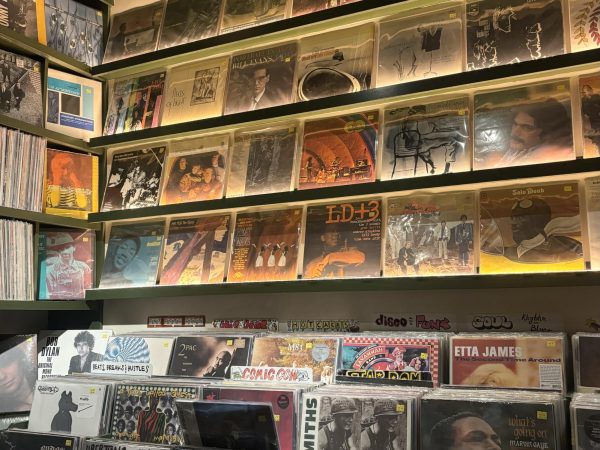
Sifting through records is not only a satisfying way to spend one’s time, but it is also an opportunity to discover hidden gems in seemingly common or easily overlooked albums. One such gem was found by Peyghambary during a visit to Streetlight Records, a record store he visits each time he returns to his hometown of San Jose, Calif.
“I’m a big fan of a band called Cranes. I was looking at Streetlight for their CDs, and they only had two. They were albums I didn’t like very much, but they were like two bucks. When I got home, I opened one of them, and the whole lyric booklet was signed by the band. … It was too perfect,” said Peyghambary. “It’s such a special moment when you find something so valuable to only yourself.”
When an album or artist incites such a deep connection, it is all the more reason to prioritize the physical version rather than a stream. Buying a copy of an underrepresented or “underground” artist’s music pays greater respect to them, especially when streaming only returns a small portion of what their work is worth.
“Sometimes I’ll want to listen to a specific artist or a specific album and I’ll think, ‘Well, I have that record, why would I not just put that on? Why would I stream it if I have the physical version of it and have the capability of listening to it front-to-back?’” Broderick said.
The security of owning a sentimental piece of artistry is what many people look to physical media for.
“Ownership of things is a concept that we’re kind of losing. … I don’t think that’s super great. You want to own the things that you have,” Peyghambary said.
“If streaming services were to disappear tomorrow, I think I would be fine. It would not be too heartbreaking… I already feel kind of guilty for using streaming services, especially Spotify, because they’re notorious for not paying their artists enough. But, if I absolutely had to, I think I could stop,” Broderick said.
The ease of choosing a song on Spotify, Apple Music or any number of music streaming services, while convenient, significantly dilutes the original ritual of music: slowing down, placing your copy of an album on your own player and taking a minute to appreciate what you spent time and effort searching for.
Those who are looking to stray away from streaming and develop a stronger connection to their music can visit local media vendors, such as Re-Animated Records in La Mesa, Vinyl Junkies Record Shack in South Park or M-Theory Music in Mission Hills.