

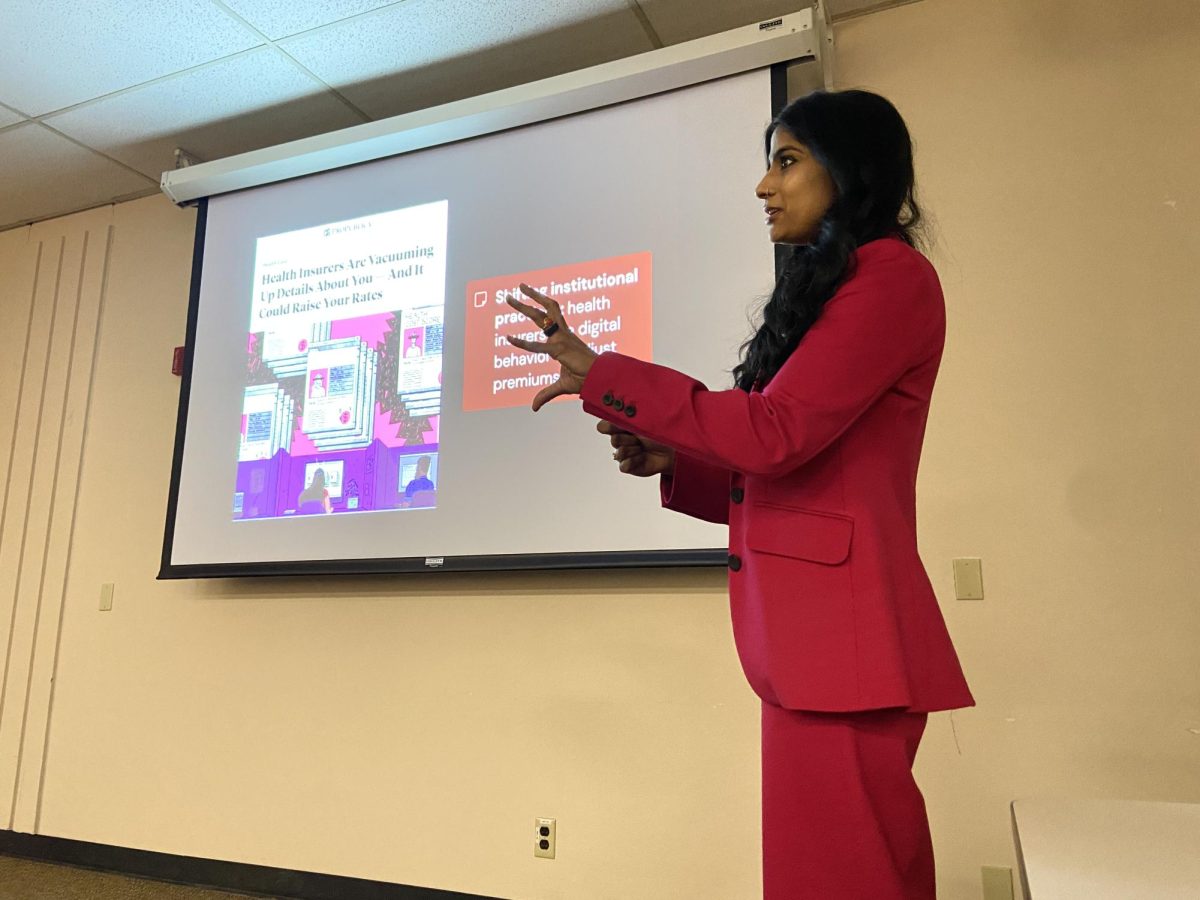
Researchers from the Marketing Department, Department of Chicana and Chicano Studies and School of Communication shared their research projects at this month’s Discoveries & Dialogues Colloquium in the Love Library on Jan. 28.
Discoveries and Dialogues is a monthly event organized by the University Research Council and Division of Research and Innovation to highlight new research coming out of SDSU. Discoveries and Dialogues consists of three, short presentations open to the general public.
Nita Umashankar, an associate professor of marketing, presented her findings surrounding consumer reactions to new threats of data surveillance.
Using about 100,000 observations through Google search data, Umashankar found that, following the overturn of Roe v. Wade, consumers were looking up how to delete social media posts and how to protect their online privacy.
In states where abortion became fully banned, surveyed women were especially concerned with deleting their online history because they feared self-incrimination.
“It’s the first time we’ve documented how consumers are actually responding to surveillance,” Umashankar said.
Umashankar also examined other examples of consumers protecting themselves from threats to their data, including social media inspection for visa applications and health data harvested by insurance companies.
Eliana Bentley, a communications graduate student in attendance, said she has deleted apps for similar reasons, and said, “All these apps are doing unethical things.”
Umashankar said she can see SDSU students being affected by this kind of data surveillance, especially when it comes to online posts about Immigration and Customs Enforcement and the Palestine conflict.
Last week, TikTok experienced a 150% increase in app deletion after USA users reported censorship of new posts, according to market intelligence firm Sensor Tower.
According to the BBC, TikTok denied claims that it is heavily controlling what users see and instead pointed to lingering technical issues from the USA division split from its Chinese parent company, ByteDance, on Jan. 22.
Another professor, Victoria González-Rivera, chair of the Chicana/o department, presented her research on the trafficking of enslaved people from the United States through Nicaragua.
González-Rivera contested the standard narrative of slavery in Nicaragua, finding that slaves were trafficked through the Central American country by Americans during a time when slavery was illegal in Nicaragua. American imperialists led by William Walker subsequently attempted to reestablish slavery there.
“Unfortunately, minimizing the importance of enslavement in Western Nicaragua during the mid-19th century has led to romanticized versions of William Walker’s brutal takeover of Nicaragua,” González-Rivera said.
González-Rivera said this type of research is difficult to fund, and slashes to federal research grants have affected the Chicana/o department, which no longer has the funds it used to.
The third presenter, Katrina Pariera, shared research on friendly conversations about sex and the stigmatization surrounding it.
Pariera found that although women were more likely than men to talk about sex with their friends, they still largely feared judgment and being perceived as gross or overly sexual.
Pariera said that although she didn’t apply for grant funding for her research, others in her department are already expecting not to receive grants, especially due to a “subtext of fear about the research topic,” such as transgender and gender-nonconforming studies.
SDSU research just became more prestigious last year after the University was designated with Research 1 status, a recognition given to schools that spend $50M in “research and development” and award at least 70 doctoral degrees.
But this new designation has not prevented SDSU from losing at least 50 federal grants terminated by the Trump administration last year, according to EdSource.
Trump eliminated federal funding to areas that don’t align with his policies, including grants for research in climate change, sexuality and vaccination.


![Courtesy Photo: Greg Thames [pulled from Pexels website as free use image]](https://thedailyaztec.com/wp-content/uploads/2026/05/Screenshot-2026-05-15-at-11.36.27-AM-1200x820.png)