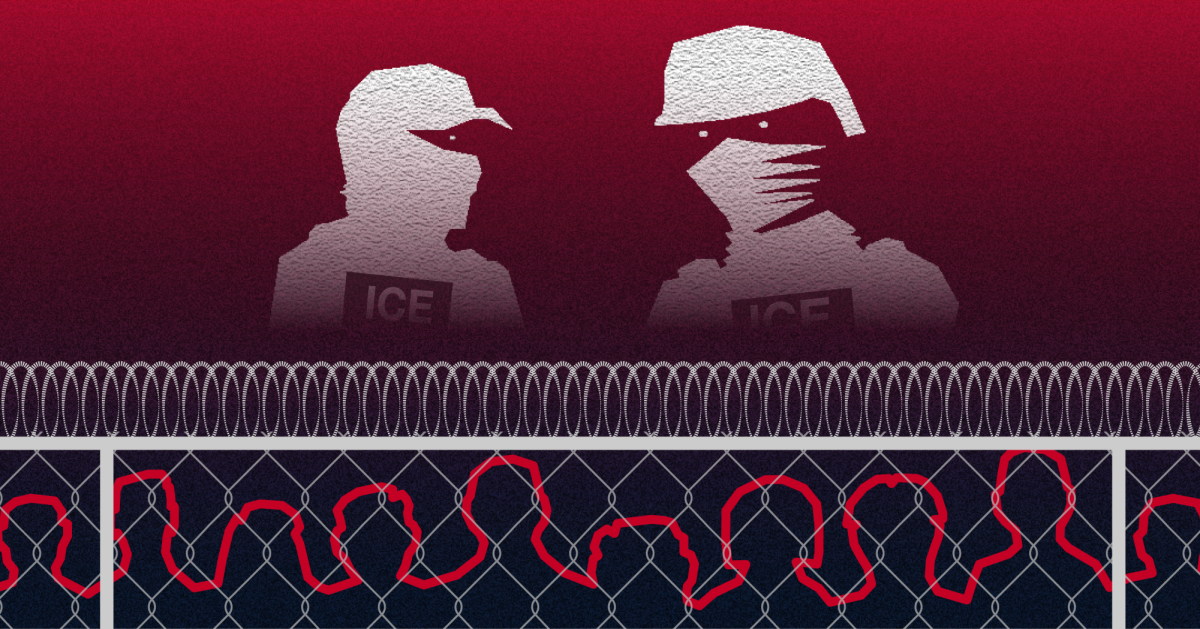
This is the story of a hardworking father who returned to work for just one day to give his teenage daughter a reprieve from being a household provider—for he’d not been attending work out of his family’s fear of him being taken. His past finally caught up with him–the one where he moved to the USA at 6 years old. This was Mr. Jimenez’s only crime: not being born in this country.
This is Carolyn Jimenez’s story—the one where her father was kidnapped after a day of hard work, profiled by the two colors he bore: brown skin and a neon orange work shirt.
This is one story of thousands across the country where livelihoods are destroyed under the falsehood of protection for citizens. This is not a new event. However, the severity of the situation has been amplified within the last year with Immigration and Customs Enforcement tactics becoming increasingly violent and mass deportations more frequent. Norlan Guzman-Fuentes, Nhon Ngoc Nguyen and Isidro Pérez are just a few names of the 32 total deaths at the hands of ICE. Especially now, following the murders of Renee Nicole Goode and Alex Pretti by ICE agents, tensions are high.
Jimenez, a 19-year-old certified nursing assistant, remembers searching for her father for hours, recalling that day as so “extremely traumatizing” that she and her siblings sought counseling months later.
“(It was the) hardest thing I’ve gone through in my entire life,” Jimenez said.
We are in a modern-day Holocaust, and if that doesn’t scare you, it should. The cruelty toward Latinos (immigrants and USA citizens alike) is a story told before, and we all know the ending. The immigration system has adopted inhumane practices that wrongfully target innocent civilians and violate the human rights of those detained.
Many choose ignorance if it doesn’t personally affect them, or maybe the reality is too harsh to face. Whatever the reason, we have a moral obligation to care—not just as human beings, but because what happens when we are next?
America’s immigration system, particularly ICE, has become a catalyst for Latino hate by tearing families apart, subjecting migrants to degrading conditions and betraying this nation’s promise of freedom for all.
Violation of Rights
ICE’s detaining tactics and violent abuses are actively violating the human rights of Latinos. While there are numerous detention facilities all over the country, three Florida facilities have caught the attention of thousands: Krome North Service Processing Center, the Broward Transitional Center and the Federal Detention Center. Within the last year, their practices have notably become abusive towards its detainees. According to inmate accounts to Human Rights Watch, there have been reports of being “shackled for prolonged periods on buses without food, water, or functioning toilets” and being “denied access to basic hygiene and medical care.” With capacities overflowing with over 56,400 detainees per day, Krome has detained more than three times its operational capacity of inmates, making conditions truly unlivable.
Family Separation and Trauma
Not only do the harmful conditions of detention facilities cause trauma in individuals, but family separation in arresting practices leave a lasting mark on families and the Latino community as a whole.
According to Dr. Lisa Fortuna, professor and chair of psychiatry and neuroscience at the UCR School of Medicine, the threat or reality of caregiver separation can fundamentally reshape a child’s development and mental health.
“We are witnessing the effects of chronic fear, disrupted attachment, and intergenerational trauma on a massive scale,” Fortuna said in a report for UC Riverside.
Parents live in constant fear of being taken from their children, while kids fear losing their caregivers. Latinos—the largest contributors to our community—are withdrawing from everyday life, reinforced by ICE raids, surveillance and arrests.
“Even kids not directly affected feel the impact when their communities are disrupted, creating a sense of collective trauma and loss of safety,” Fortuna said in the same interview.
Jimenez, a California native, described the “shambles” her family was left in, only able to see her father for 45 minutes a week in a cold detention center.
“I lived a constant nightmare,” Jimenez said.
Accountability and Oversight
These situations underscore the lack of safeguards and oversight in the immigration system that prioritizes speed over efficiency. Additionally, the Department of Homeland Security and its Secretary, Kristi Noem, have published campaigns designed to incite fear in immigrant communities.
“Thank you, President Donald J. Trump, for securing our border, for deporting criminal, illegal immigrants and for putting America first,” Noem declared in a DHS video.
This statement highlights a disturbing lack of accountability, reflected in the failure to acknowledge a jarring statistic, that nearly 72% of those detained had no criminal history.
The causes of this crisis trace back to two things: a flawed immigration system and new, inhumane policies.
Bureaucratic Inefficiency
Since the Immigration Act of 1891, the processing system for those coming to the USA has been an ever-evolving and ineffective process. David Bier at the CATO Institute compared this process to the lottery system.
“Even when someone qualifies, annual immigration caps greatly delay and, more frequently, eliminate the immigrant’s chance to come to the United States,” Bier wrote.
Legal immigration status can be obtained through refugee programs (with less than a 0.1% chance of resettlement), Family Sponsorship (where most will die before consideration) and employer sponsorship (excluding those without college degrees). A system designed with hurdles pushes many toward the illegal alternative. This, paired with predisposed Latino hate, creates a corrupt system.
Systemic Bias and Criminalization
According to an article published by The Brookings Institution, Senior Advisor Charles Kamasaki analyzed the USA’s long documented history of acceptedness towards European immigrants and harsh enforcement towards those of color today,
“[…]from the early 1900s through the 1960s, millions of predominantly white immigrants entered the country unlawfully, but faced virtually no threat of apprehension or deportation […] By contrast, the undocumented population today—mostly Latino and overwhelmingly people of color—none of the privileges accorded to previous generations of white immigrants,” Kamasaki wrote.
Bias toward immigrants has shaped the system. The U.S. accepts the “Fruits of Migrant Labor,” but not the immigrants themselves.
This racial bias perpetuates a flawed system turned inhumane. The Network Advocates for Catholic Social Justice in a 2024 report stated that “the origin of this cruel immigration enforcement system was the 2003 decision to create ICE and move immigration under the purview of the Department of Homeland Security.”
In turn, this criminalized undocumented immigrants for the first time. And while immigration policy has long been faulty, the Trump Administration “implemented changes to ICE tactics, upping raids and deportations and making them crueler.” Executive Orders like 14159 further expand ICE’s power and push an anti-immigrant agenda targeting Latinos nationwide.
Solutions
History is repeating itself, but history also shows hope for reform.
Accountability from government and immigration agencies is crucial. One solution is expanding in-person oversight visits to detention centers and border locations by elected officials and human rights groups. The Government Accountability Office notes that these groups can also work to hold ICE federally accountable through changes such as:
(1)regularly analyze complaint data at a level necessary to identify and address potentially reoccurring complaints and (2) require field offices to record actions to resolve complaints in a timely manner.
“These opportunities for improvement would contribute to better management, conditions of confinement and use of federal funds,” the Government Accountability Office summarized.
In a world that’s tangled with fear, it’s important we utilize our democracy to push back. Civilian and government discourse—a core component of our government and our system—has proven effective.
As students, advocates and humans we not only need to advocate and increase awareness of the immigration crisis, but we also need to reframe the conversation from politics to human rights. Education and educating are key in amplifying the movement, as is supporting human rights advocacy organizations.
The current immigration crisis is quite simply a moral failure of this nation’s values but we must use our power in democracy to push back. We are witnessing people’s humanity be stripped away by others’ cruelty. ICE’s actions are a direct violation of basic human rights and they have traumatizing effects on the Latino community. Inaction will only continue to infect current policy until all that remains of an anti-immigrants agenda is the bare bones where a hardworking community once stood.
Jimenez noted how it was “so dehumanizing to see” her father being stripped of his humanity.
“You never think it will happen to your family,” she said.
But it did.
We need to care, because what happens when it’s us next?
Resources dedicated to helping the cause
https://www.rescue.org/united-states/san-diego-ca provides opportunities for refugees, asylees, victims of human trafficking, survivors of torture, and other immigrants to thrive in America (San Diego based).
https://lataco.com/donate-non-profits-immigrant-rights has a collection of 31 nonprofits dedicated to supporting immigrant rights.
https://www.ilrc.org/what-we-do is a national nonprofit resource center that provides immigration legal training, technical assistance, and educational materials, and engages in advocacy and immigrant civic engagement to advance immigrant rights
https://www.borderangels.org/ provides life-saving humanitarian aid along the entire U.S.-Mexico border
https://hias.org/news/seven-ways-take-action-immigrants/ shows how you can support immigrants in your workplace, your school, and on your block
https://nnirr.org/education-resources/community-resources-legal-assistance-recursos-comunitarios-asistencia-legal/immigration-hotlines-lineas-directas-de-inmigracion/ has a list of national, state and local Immigration Hotlines to report raids/ICE activity, seek help if being detained, report missing migrants
https://unidosus.org/ the largest latino civil rights organization in the USA that combines research, advocacy, programs, and more.
https://www.freedomforimmigrants.org/child-detention-stories a multimedia project that features artwork entirely from mothers, fathers, and children in immigration detention.