


SDSU Students for Justice in Palestine put up mock apartheid walls covered with information and political art about the Palestinian genocide, outside of Hepner Hall on Feb. 11.
The four 10-foot-tall wooden walls featured bold text and striking images meant to grab the attention of passing students.
“The whole idea is it’s in people’s faces,” said Muhamed Erekat, an organizer with SJP and a fourth-year civil engineering major. “And so it is the starting point for people who don’t know much.”
Mock apartheid walls are a form of protest used by Palestinian liberation activists to symbolize the walls constructed by Israel around the occupied Palestinian territories of Gaza and the West Bank.
Israel describes the walls as a necessary security protection, but Palestinians have denounced them as an annexation tactic. The International Court of Justice declared the West Bank wall illegal and demanded its dismantling in 2004 because 85% of the wall is built within Palestinian territory, according to Al Jazeera.
On Sunday, Israel ratified measures to expand its power to seize land in the West Bank and build illegal settlements, which would displace even more Palestinians.
The mock apartheid walls outside Hepner Hall functioned as more than just an education on the occupation in Palestine. They explain how Israel trains American immigration officers and how zionism in Palestine relates to the history of colonialism in the U.S.
Matt Miuccio, a philosophy graduate student, found that the “poignant” displays were a good way to get people to stop and learn.
“It’s almost like a museum,” Miuccio said, “as though you can walk around and view things for yourself and make your own judgments about them.”
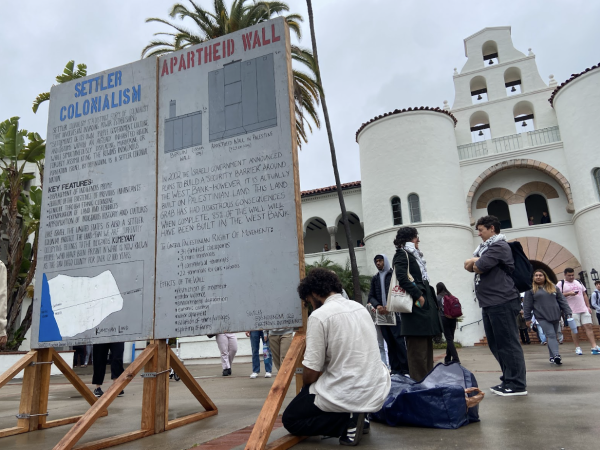
Yasmin Zeis-Khalil, president of SDSU SJP and a fourth-year political science major, said the event’s purpose was to engage with students and encourage them to ask unfamiliar questions.
She hopes to bring more political activism to SDSU and pointed to student activists during apartheid in South Africa and the Vietnam War as a source of inspiration.
She also explained that SJP had demanded the university divest from companies complicit in genocide and created mock apartheid walls in the past.
But SDSU makes it difficult for student organizations to protest on campus. Strict policies surrounding the time, place and manner of protest forced SJP to work with the California Faculty Association and Students for Quality Education to reserve the space as a union, according to Zeis-Khalil.
She said that it’s necessary to work around the system to create change.
Through these walls, Zeis-Khalil also hopes to humanize Palestinians and mentioned how constant media coverage has desensitized people to the severity of what is happening.
“People have found a way to be okay with seeing people dragged in the streets because they look different, because they speak a different language,” Zeis-Khalil said.
“And we need to re-humanize our empathy.”

![Courtesy Photo: Greg Thames [pulled from Pexels website as free use image]](https://thedailyaztec.com/wp-content/uploads/2026/05/Screenshot-2026-05-15-at-11.36.27-AM-1200x820.png)