

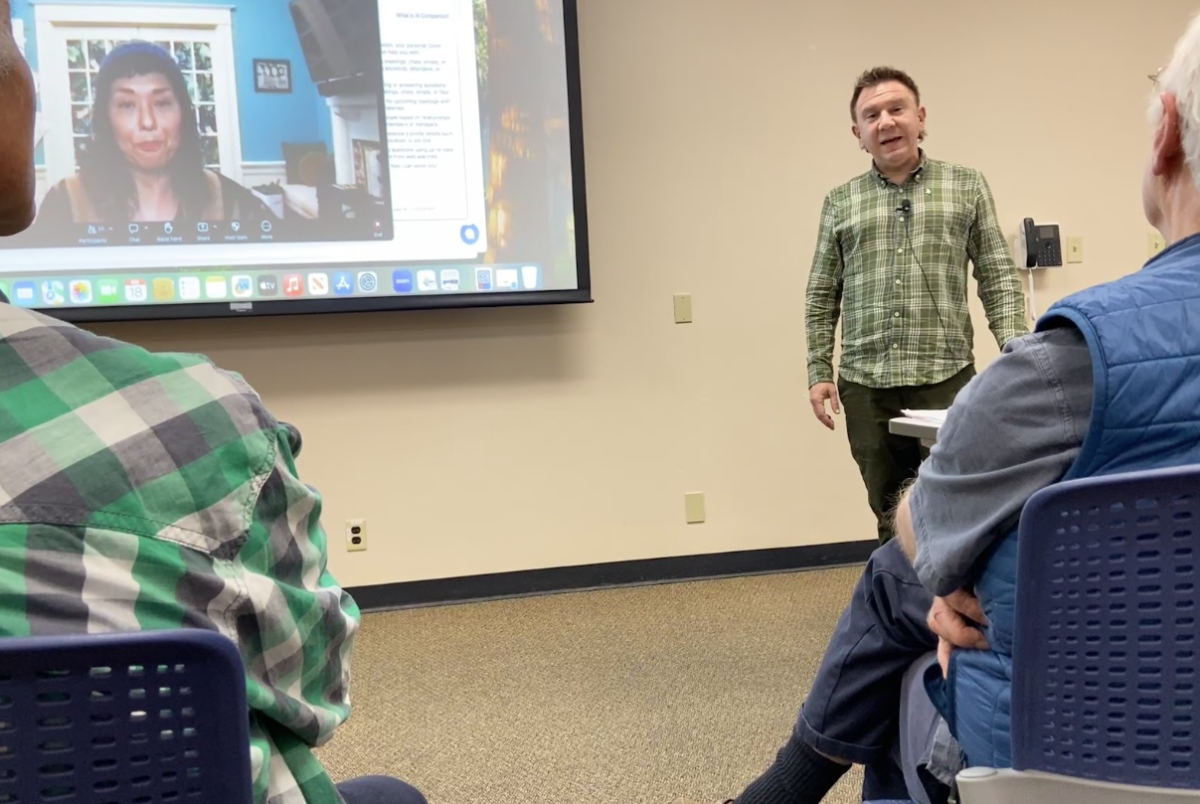
The SDSU Political Science Department hosted “No One Is Safe: Assaults on Academic Freedom in the United States,” an event highlighting a rising trend of attacks on tenure and faculty speech, in the Love Library on Feb. 18.
Two professors fired for political speech, one from San Jose State University and the other from Texas State University, told their stories and discussed threats to free speech in academia.
Sang Hea Kil, who taught justice studies at SJSU, and Tom Alter, who taught history at TXST, are fighting their terminations, claiming they were fired because of their political activism, without just cause.
Kil was placed on paid leave in May 2024 for allegedly violating university policies within her position as a faculty advisor to Students for Justice in Palestine.
According to Kil, SJSU cited incidents in which Kil spoke at a protest and violated the university’s time, place and manner policy.
While on administrative leave, she was investigated by the university and was then fired in June 2025. Kil is the first tenured professor fired from a public university because of protest against the genocide in Palestine.
“They need to attack the tenure system because that’s job security,” Kil said. “And [tenure] gives you the right to speak out and push back in a different position than lecturers who are more vulnerable to layoffs and harassment.”
Kil claimed the university’s investigation into her was influenced by Hillel Silicon Valley, a nonprofit that fosters connections between Israel and college students. She said she saw email correspondence in which Hillel demanded that SJSU’s president “open an investigation” into Kil.
Kil appealed her termination in November 2025, and a faculty hearing committee found her dismissal was unjustified.
But SJSU President Cynthia Teniente-Matson overturned the decision and terminated Kil.
Kil is one of many faculty members and students punished by their university for involvement in Palestine solidarity protests over the last two and a half years.
“So many of our Muslim, Arab, SWANA (Southwest Asia and North Africa) students were targeted for supporting Palestine and the Popular University for Gaza,” Kil said. “And I don’t think that [the administration’s] project against higher ed is over.”
Kil is seeking reinstatement through arbitration with the help of her union, California Faculty Association, which represents 29,000 faculty in the state, including many at SDSU.
On Nov. 21, 2025, CFA presented new contract proposals to CSU management, including a new article concerning academic freedom, which Kil said she co-wrote. This proposal outlines provisions that would secure faculty’s rights to discuss controversial topics, to receive protection from censorship and to “resist fascism.”
CFA wrote in an article that “The Chancellor’s Office has now, more than ever, intensified its attacks on academic freedom as a means of suppressing lawful speech.”
Tom Alter, another victim of attacks on academic freedom, was fired from TXST in September 2025 for speaking at an online socialist conference.
An out-of-context video recording of Alter describing the overthrow of the U.S. circulated on X, where he was identified as a Texas State professor.
University President Kelly Damphousse claimed Alter was “inciting violence” and summarily fired him.
“I could be the first professor fired with no due process, not even a sham kind of predetermined due process,” Alter said. “And as we know, higher education and democratic rights in general have been under attack for years.”
Alter is now suing the university, claiming it violated due process, free speech and academic freedom rights.
Both Sang and Alter connected their terminations to broader changes in the priorities of college institutions, which have become more profit-driven. While student tuition increases and faculty and staff salaries stagnate, administration salaries are skyrocketing.
“[The university] shouldn’t be tied to making profits,” Alter said. “It should be about making knowledge.”
Alter also said that an attack on the academic freedom of faculty is an attack on the quality of education for students, who won’t “have the ability to learn from all different perspectives.”
“It goes beyond the case of a simple professor,” he said. “[It] has ramifications for all of us who care about justice and democratic rights.”

![Courtesy Photo: Greg Thames [pulled from Pexels website as free use image]](https://thedailyaztec.com/wp-content/uploads/2026/05/Screenshot-2026-05-15-at-11.36.27-AM-1200x820.png)