For some San Diego State athletes, NIL does not arrive as a six-figure check or a donor-backed collective payment.
Sometimes, it looks like a parent wearing their kid’s jersey in the stands, which is where 978 Jerseys has found its place in SDSU’s name, image and likeness landscape.
Not at the top of the NIL food chain, where football and men’s basketball dominate the headlines, but in the smaller space where athletes from all other sports can sell apparel with their name and number on it.
The company, founded by Ethan Chandler, began its college NIL apparel model with San Diego State. Three years later, 978 Jerseys has expanded to seven schools, but SDSU remains the center of its business.
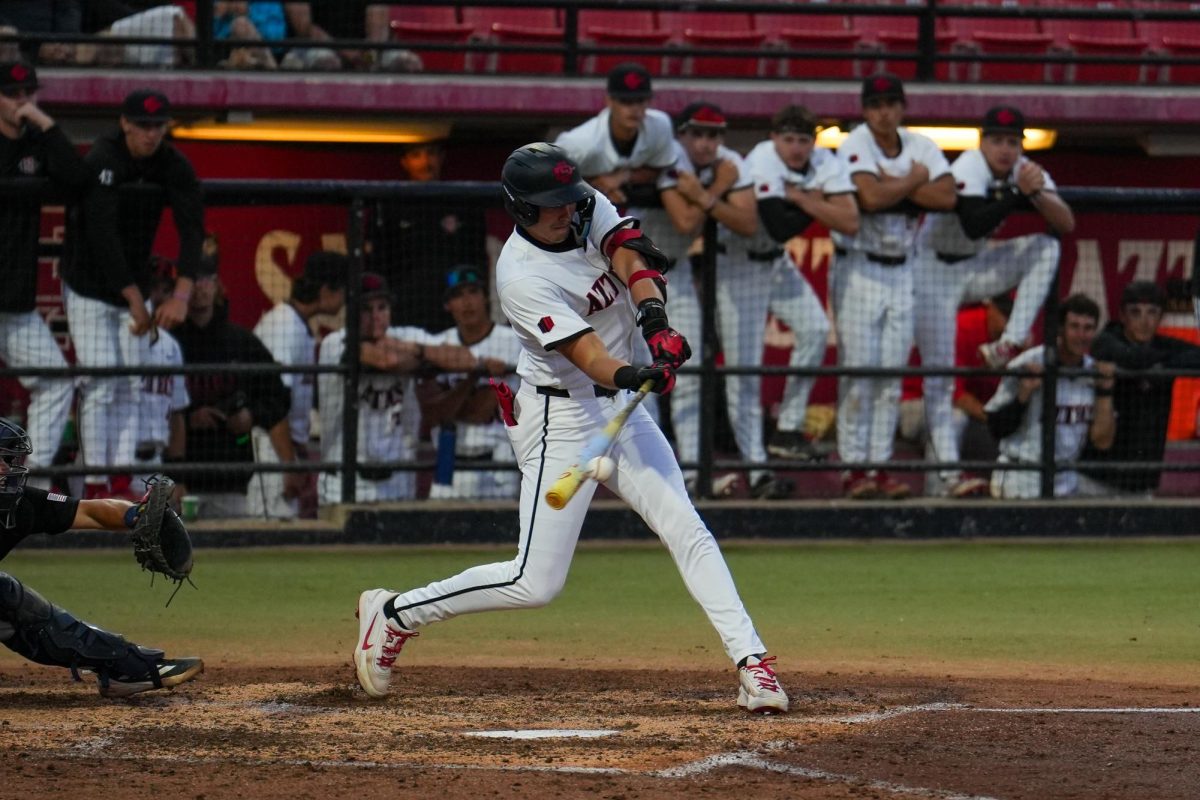
“San Diego State was our first school,” Chandler said. “This is our third year doing the SDSU football team, and then we just finished up our second season with the SDSU baseball team.”
The company has since paid out more than $12,000 in royalties to SDSU student-athletes, according to figures from 978 Jerseys that Chandler said reflected sales for the school’s collections.
It is not life-changing money.
But in the current NIL landscape, where the biggest deals still flow toward the biggest names, the platform gives SDSU athletes something many have never had before in their own merchandise line.
978 Jerseys operates as a third-party NIL vendor. The company applies for a school licensing agreement, which allows it to use San Diego State’s name, colors and logos. SDSU approves designs and receives a royalty from each item sold. Separately, 978 Jerseys signs agreements with athletes to use their name, image and likeness.
The athletes receive royalties on each sale, generally in the 10%-20% range, depending on the item. Higher-priced items, such as football or baseball jerseys, generate larger payouts than lower-priced items such as pennants or shirts.
“Everyone has the same set royalty rate for all of their products,” Chandler said. “The higher-priced items have a higher royalty.”
That matters because not every SDSU athlete has access to the same kind of product.
Football and basketball players can sell jerseys, which is usually the biggest money-maker. Athletes in sports without traditional replica jerseys often rely on shirts, hoodies, hats, pennants, stickers or other merchandise.
“I think NIL was really meant to be inclusive of all athletes,” Chandler said. “Especially since a lot of those athletes don’t have that jersey. So we substitute that with lots of non-apparel options.”
The company’s SDSU store includes athletes from football, baseball, basketball, softball, soccer, volleyball, lacrosse, golf, tennis, water polo, swim and dive, track and field and cross country.
SDSU baseball right-hander pitcher Rohan Lettow found the appeal simple.
“I thought it was just really cool,” Lettow said. “My friends and family can have jerseys with my number and name on it, and it supports me as well.”
Lettow believes the platform helps bring baseball further into the NIL conversation.
“A lot of fans are coming out to watch more,” Lettow said. “A lot of people are starting to follow not only the MLB, but college baseball, too. With 978 Jerseys and the whole NIL thing, I think it’s going to bring baseball to the next level.”
SDSU outfielder Zane Kelly saw it the same way, but through his family first.
“My family really wanted to wear a jersey of mine,” Kelly said. “The only way you can really get that is through them, so it was a super easy choice.”
Kelly said he has not made enough to call it a major financial change, but enough to notice.
“I’ve had people buy my jerseys,” Kelly said. “I’m not rich, but a couple meals here and there, I’m grateful.”
Softball infielder Shannon Cunningham first heard from 978 Jerseys through Instagram after transferring to San Diego State from Arizona State. What caught her attention was the design.
“When I saw how similar the 978 ones were to our own jerseys, it made me want to sign up,” Cunningham said. “I knew my parents had always wanted a jersey of mine.”
Cunningham said the financial return for athletes in lower-revenue sports is usually modest.
“You’re not really making a lot of money,” she said. “For me, the impact is just having my family have something to wear representing me. Seeing them with T-shirts with my number, my name on it or pictures of me, that’s the fun part.”
Then came a moment she did not expect.
A young softball player who had watched SDSU in regionals bought Cunningham’s jersey and later dressed up as her for Halloween.
“That was probably one of the coolest moments of my life,” Cunningham said. “I thought it was the best thing ever.”
That is the quieter side of NIL, away from portal bidding wars and collective payrolls.
“A lot of people think every athlete is getting handed money,” Cunningham said. “It’s not really like that at all.”
The company says it offers athletes free sign-ups, non-exclusive agreements, custom product collections and bonuses for sales milestones. Its pricing strategy is built around keeping products affordable for families, students and fans.
“We’d rather keep our prices low to increase our customer selection,” Chandler said. “The higher you go, you’re going to delete some of those demographics that might not be able to afford a $145 jersey.”
The company has also used monthly sales rankings to highlight SDSU athletes across sports. In October 2025, SDSU athletes earned more than $500 in royalties, according to a 978 Jerseys Instagram post, with top sellers from football and basketball.
In November, 978 Jerseys said its NIL athletes across schools earned more than $2,000 in royalties, with SDSU men’s basketball players Tae Simmons, Reese Dixon-Waters and Thokbor Majak among the top five.
978 Jerseys does not solve the larger NIL imbalance between revenue sports and everyone else. It does not turn a softball infielder or baseball pitcher into a high-dollar NIL earner overnight.
But it gives them a spot in the marketplace.
And in a college sports economy increasingly defined by money, that still counts for something.
“It’s just another way to get some money to help out the athletes,” Lettow said. “Everyone needs a little bit of help sometimes.”