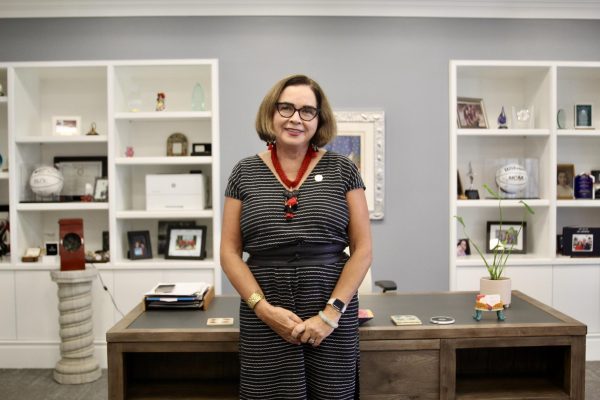
With the fall semester starting, President Adela de la Torre sat down with The Daily Aztec Co-Editors-in-Chief Friday afternoon.
Throughout the 30-minute interview, de la Torre offered her insights on system-wide Artificial Intelligence implementation, undocumented and international community support initiatives, the broader Greek life community, increased university partnerships and the importance of accelerated degrees in the wake of federal funding concerns.
A day in the life of President de la Torre
When asked about her day-to-day as President, de la Torre discussed the importance of moderating her feelings and engaging in self-care. Each morning, she rides her Peloton, pets her dogs and listens to meetings or a podcast to start out the work day. De la Torre explained that her days primarily consist of back-to-back meetings with various deans and campus leaders. She also makes it a priority to connect with Associated Students leaders.
“I have a tradition where the Associated Students President brings students to the [President’s Office] and we have lemonade and cookies,” de la Torre said. “Then I have an open forum, and we have 10 to 15 students that I basically say, ‘Ask me anything you want to ask me. Give me any comments that you have, negative or positive.’”
Supporting SDSU’s undocumented and international communities
In her remarks, de la Torre expressed her gratitude for the Monarch Unity Resource Center. As stated on the center’s website, “The programs and services we provide focus on retention, graduation, community building, and the overall well-being of all students, especially our immigrant students.” Services include general academic advising, as well as immigration legal consultation, Deferred Action for Childhood Arrivals (DACA) renewal assistance and community resource navigation.
“[The director of MURC] has really made it her mission with my deputy chief of staff … and really creating trainings that are about how to approach the issue [if], in fact, you are approached by ICE,” de la Torre said. “And we have a very good protocol. We have an individual both on the campus here … and then on Imperial campus, Imperial Valley, who, if at any moment a department head or an individual is concerned about what they’re observing, they can contact that individual immediately for guidance and assistance.”
De la Torre also acknowledged “the visa issue,” referring to recent increases in revocations and denials, particularly for student visas.
“On an individual level, we have been on direct conversations to assist [visa holders] through that process, and to the extent that we can accommodate, particularly those who have been delayed through either enrollment, asynchronous opportunities or other opportunities for them to get into their curriculum until they can come to campus,” she said. “So, we’ve been really mindful to really focus at the local individual level to ensure that individuals have the tools while respecting the fact that people want to have their privacy … I do think that we’ve really created a very important, tailored approach that allows people to not only utilize services here, but use services that are in the community that are equally important. Because it is requiring people to understand that we’re going to have to collaborate. We’re going to have to work with other people and we’re going to have to work with other systems in order to support this particular moment in history where there is so much fear and uncertainty, right? It’s not something that one institution can handle alone.”
AI implementation
Regarding AI, de la Torre spoke to the velocity of AI as a new technology, remarking that its “radical impact” has spread faster than the internet.
She also referred to a student survey, conducted in fall 2023, that had an unusually high participation rate of 21%. The survey was replicated one year later to include staff, faculty and additional student responses, with a participation rate of 26%. The surveys asked questions surrounding awareness, prior experiences, perceptions and predictions of AI, as well as if/how they would like to see it integrated into SDSU curricula.
“What we found out from our students was that [they] are using AI,” de la Torre said. “I think like 80% were using it, and that’s increased. But what we also found out — where the students were concerned — [was] that they would be accused of cheating if they used it. They really wanted to know, ‘How do I navigate something that I’m already using in a way in which I’m not penalized,’ but they knew it intuitively that the skill set would be improved with it … If you look at our strategic plan, students are at our core, [and] in my opinion, is the North Star for San Diego State. The students’ voices sometimes will not be heard, largely because, as you well know, sometimes the loudest voices are heard. But, because we had this data, it was very easy to bring the conversation in to the chairs and directors.”
De la Torre affirmed her goal to prepare students for career success, particularly referring to A.S. Career Advantage, established in 2023.
“We really need to think about how best to position our students, because when they leave, although we want to minimize any debt, we also want them to move out with a job … that we’re putting them with the tools in order to do that … It became clear that we couldn’t just linger around and do it in a haphazard manner, that it is part of what our students want. They’re interested in moving into their passions and dreams, and we need to create the tool set that’s needed for them. It was really situated in the student voice. If our student voice had not been so strong here, I probably would have lingered a little more, but it was clear that the pieces of the students that are coming in, they want engagement with this.”
De la Torre also addressed the realities of how students might use AI, as well as concerns surrounding how AI could be implemented in higher education ethically and usefully in a faculty full of varying skillsets. See SDSU’s full Generative AI usage guidelines here.
“The fact is, our students are multitasking. They are scaffolding activities in different ways, and they’re not cheating, although I know students cheat. I mean, let’s be realistic, in any campus this size, you’re gonna have cheating,” she said. “My point here is, it was clear to me that we had to work with the faculty, and that’s why James Frazee, our Vice President and CIO, developed, with the faculty that are part of his fellowship program, the micro-credential. And the micro-credential provides a really good mechanism to understand the ethical use and the tools available.”
In April, the California Faculty Association filed a charge against CSU management, claiming that they failed to consult faculty before launching a major OpenAI partnership, as reported by The Daily Aztec.
More recently, the CSU secured enterprise licenses to Google Gemini and Microsoft Co-Pilot, in addition to OpenAI’s ChatGPT, to provide system-wide access in a closed information system.
“We worked with the A.S. leaders to help in pushing it out, and then we created training programs for our faculty, because we want AI across the curriculum,” de la Torre said. “We want every major student to have a course using AI so that they feel comfortable with it. We don’t want them to feel guilty. This notion of guilt is not appropriate with a new technology, and we need to have champions of our faculty who also are there to help in a peer-to-peer [way] … And I think effectively what we’re doing is we’re providing the opportunity for our faculty [to] use the AI opportunity through a training module that we’re providing, we provide a stipend for faculty, recognizing their time is valuable.”
Greek Life
In the context of Greek Life at SDSU, the university already has measures in place to minimize alcohol usage, sexual assault and hazing at the start of each semester, referred to as “dry period.” When asked about her position on Greek life following a recent spate of suspensions, de la Torre emphasized the importance of “very robust educational training,” with respect to anti-hazing efforts. De la Torre referenced the 2019 Presidential Task Force that was later finalized to include the Good Samaritan Policy as a guideline for all Recognized Student Organizations.
“We want students not to be penalized, to be honest when they observe,” de la Torre said. “So, when [students] observe something that isn’t appropriate, even if they’re involved in it, they have an opportunity to do that without any concern about an adverse action occurring to them, and that’s been very, very effective. I think we’ve also been able to, as a result of that particular Presidential Task Force, have a hazing prevention task force. So, we’ve been very proactive in this area, given the size of the Greek Life community here.”
De la Torre elaborated on the impact of the Greek Life experience for students, as parties and gatherings are often pushed off campus as an effort to avoid getting in trouble within the university. When asked if she felt these efforts were pushing the problem onto the city, she stated, “not really,” and reassured that the campus is doing everything in its power to prioritize student safety.
“If you are a student, you’re still held accountable for the conduct violations that you have,” de la Torre said. “So if you ask Chief Murphy … we work very closely with the San Diego Police Department. In fact, in the last three weeks, we had a very strong police presence around the community areas where a lot of those parties occur … Our neighbors in those communities will call us and complain. They’re not timid, and we really intervene, particularly when the behavior goes out of line. So, I think in a sense, what we’ve seen is a strengthening of the partnership with the San Diego Police Department. Our own ability to work effectively in prevention is largely when we’re able to step in, when appropriate, recognizing that students also have a right to have a party, but they have to follow within what the community expectations are.”
Although she recognizes the inevitable challenges that come along with having a Greek life at such a large university, de la Torre emphasized the importance of the community and alumni connections that these social organizations bring to the table.
“More recently, of course, we were able to do the endowment for the Fred Pierce Greek Life Center with the idea that we want to understand and strengthen these important bonds, because if you look at the over 500,000 students who graduate from San Diego State, many, many, many have participated in Greek life,” de la Torre commented. “It’s played a very important role in their lives, and it has built, if you will, strong alumni and relationship ties that continue to this day. So, the issue is to work within the context of our educational mission, strengthen protections for students, and then create an environment where people feel safe, because safety is really critical, and we want the parents to feel that those students are safe.”
The Future of Federal Education Funding
Amid federal budget cuts and the cost of tuition continuing to rise, many community members worry about the future of higher education. De la Torre contextualized this issue, stating that CSU as a whole determines tuition increases, leaving state budget deficit issues and the uncertainty of dependents largely in the hands of higher-up decision-makers.
“The funding issue is a complex question, largely because we also have a budget deficit at the state level,” de la Torre said. “We have uncertainty at the state level about the type of overall funding that the state depends on, and because neither the UC or the CSU has an obligation like Prop 98, where a certain percentage of funds go to community colleges or to K-12, we’re more vulnerable politically to funding cuts. So that’s California, in a nutshell. That uncertainty has actually lingered for many, many years, and the ebbs and flows of funding are a phenomenon of how we fund higher education here in California.”
De la Torre also brought up the issue of graduate education funding as caps on subsidized loans become stricter for specialized programs.
“When we look at graduate education, that is really a very serious area, because the cap on amounts that are available for graduate students, particularly for students who want to go into professional fields like medicine or even some of the areas like physical therapy, because there are caps on what you can borrow that are subsidized,” she said. “That’s going to make a difference on decisions that our students will have. So, it is going to change. It’s going to change the opportunities for students.”
With respect to budget cuts on both a state and federal level, de la Torre spoke about the university’s plans to partner with the San Diego Community College District as a way to alleviate the financial burden that comes with pursuing higher education.
“What you’re seeing is what happens when you have no state and federal funding,” de la Torre said. “You’re going to have to look at other funding mechanisms.” She offered an example: “what we’re doing in Mission Valley, which is looking at private-public partnerships, or public-private partnerships. The best example is what we’re doing with San Diego Community College District … We are building a building that the four community colleges will be housed. So, they’re paying for the construction. They have bond financing … So we’re going to have guaranteed transfer pathways. We have accelerated degrees, because that reduces the cost. If I can get you out in three years, it’s cheaper than if I get you out in four years. So you see greater collaboration, greater public, private, public partnerships, largely because there are fewer dollars that are guaranteed.”
Final thoughts
In her closing remarks, Daily Aztec leaders asked if there was anything students should be aware of, to which de la Torre elaborated on the importance of expanding the university.
“I think one of the great opportunities here for San Diego State is really expanding access to students,” she said. “We had 123,000 students apply. And I think the freshman class application was 95,000. We have an amazing institution with opportunities that — if we could expand access to — could really benefit a larger body of students. And so I do think the future for us will be … how we expand access, and how do we do it in a way in which the students are able to get the maximum ROI, in terms of meeting their passions and meeting their career goals? Because I do think you have to have both, and you can have a career goal, but if you’re not passionate, it’s going to be hard to stay in that area.”
Lastly, de la Torre provided some examples for innovation and navigating the university’s larger goals alongside funding realities.
“Some of our veterans who’ve been working in the military, to what extent that experience can count towards units? How do we become more innovative? [Our faculty] are really understanding the fact that we’ve got to do more with less, but we’ve got to do even a better job. So that’s kind of interesting, because people always want more and more. They want more money. They want more programs, more activities, she said. “I think the mantra is, in this kind of particular quagmire we see ourselves, we actually have an opportunity to transform our ways, to increase access to our students in a very different way. So, I think that’s an exciting time. Granted, it is a difficult time, so I don’t want to minimize all of the stressors that are out there that are affecting institutions, but we’re a very unique community, very special community. Quite frankly, we’re the best community, in my mind.”



![Courtesy Photo: Greg Thames [pulled from Pexels website as free use image]](https://thedailyaztec.com/wp-content/uploads/2026/05/Screenshot-2026-05-15-at-11.36.27-AM-1200x820.png)